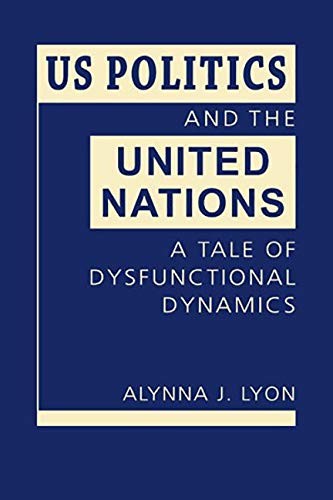
US Politics and the United Nations
0
0
As an Amazon Associate and affiliate partner, Menrva Books earns from qualifying purchases. Learn more
Author Description
It is no secret that the US variously pulls away from the United Nations and embraces it as a significant venue for policy initiatives. But what explains this dramatic inconsistency? What is the logic of US multilateralism? Alynna Lyon explores the puzzling waxing and waning of US support for the UN, tracing events, actions, and decisions from the end of World War I to the present. Lyon weaves together a consideration of international context, UN institutional dynamics, and US domestic politics to conceptualize and explain the trials and tribulations of the US-UN relationship. In the process, she tells the story of the progression of the US from a country committed to internationalism to one full of dysfunctional partisanship, ideological underpinnings, and domestic power struggles that undermine its capacities to cooperate on a global scale.
Menrva's Summary
THE THESIS
This book investigates the fluctuating and often contradictory nature of US engagement with the United Nations. Alynna Lyon, drawing on her expertise in political science, examines the historical trajectory of the US-UN relationship from the aftermath of World War I to contemporary times. The analysis integrates the influence of international contexts, the internal dynamics of the UN, and the complexities of US domestic politics to explain the shifts in American support for multilateralism. Lyon argues that the evolution of US foreign policy, marked by increasing partisanship and domestic power struggles, has significantly impacted its capacity for global cooperation.
THE SCOPE MAP
- Analysis of US policy towards the UN from post-WWI to the present.
- Examination of international context, UN institutional dynamics, and US domestic politics.
- Conceptualization and explanation of the US-UN relationship's inconsistencies.
- Discussion of the shift in US foreign policy towards internationalism and its current challenges.
- Exploration of partisanship, ideological underpinnings, and domestic power struggles affecting US cooperation.
THE AUTHORITY PERSPECTIVE
The book is likely to be regarded as a thorough academic examination of a complex geopolitical relationship. Its strength lies in weaving together multiple analytical threads—international, institutional, and domestic—to provide a nuanced understanding of US-UN dynamics. The author's approach suggests a text that will appeal to scholars and students of international relations, foreign policy, and American political history. It offers a framework for understanding the persistent tension between US national interests and its role in global governance.
Page Count:
251
Publication Date:
2016-01-01
ISBN-10:
1626374562
ISBN-13:
9781626374560
History
Non-Fiction
Politics
American Politics
Foreign Policy
International relations
Community Tags
Similar Books