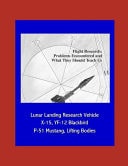
Flight Research: Problems Encountered and What They Should Teach Us - Lunar Landing Research Vehicle, X-15, YF-12 Blackbird, P-51 Mustang, Lifting Bodies
0
0
As an Amazon Associate and affiliate partner, Menrva Books earns from qualifying purchases. Learn more
Author Description
Milt Thompson's account of lessons to be learned involves aspects of the history of flight research at what was then called the Flight Research Center and its predecessor organizations- redesignated in 1976 the Hugh L. Dryden Flight Research Center. Many fascinating topics are covered: lifting bodies, the P-51 Mustang, X-planes, XS-1, X-15, the YF-12 Blackbird, the Space Shuttle, and the Lunar Landing Research Vehicle. From the time of the Wright brothers' first flight in 1903 until the end of World War II, airplane technology evolved considerably. The early decades' mono-and biplanes of wooden framework, typically braced with wire and covered with cloth, gradually gave way to an all-metal construction and improved aerodynamic shapes, but most aircraft in World War II still featured propellers and even the fastest of them flew at maximum speeds of about 450 miles per hour. For example, the North American P-51 Mustang, one of the finest prop fighters used in the war, had a top speed of 437 miles per hour when flying a level course at low altitude. This compared with low-level maximum speeds of 514 and 585 mph respectively for the Messerschmitt Me 262A and Gloster Meteor F. Mk. jet fighters, both of which thus still flew well below the speed of sound (Mach 1) in level flight. Even so, during the early 1940s, airplanes like Lockheed's P-38 Lightning began to face the problem of compressibility in dives -characterized (among other things) by increased density, a sharp rise in drag, and disturbed airflow at speeds approaching Mach 1. In partial contrast to flight test, flight research sought and seeks fundamental understanding of all aspects of aeronautics, and in achieving that understanding, its practitioners may fly experimental aircraft like the early X-planes and the D-558s or armed service discards like early production models of the F-15s, F-16s, and F-18s researchers at Dryden are modifying and flying today. Background: Flight Research at Dryden, 1946-1979 * Prob
Menrva's Summary
THE THESIS
This book investigates the critical lessons learned from flight research challenges encountered with experimental and operational aircraft. Milt Thompson, drawing on his extensive experience at the Flight Research Center (now Hugh L. Dryden Flight Research Center), details the historical evolution of flight research from the early 20th century through the late 1970s. The work covers a wide array of aircraft, including lifting bodies, the P-51 Mustang, various X-planes, the X-15, the YF-12 Blackbird, and the Lunar Landing Research Vehicle, examining the technical hurdles and fundamental aeronautical understanding gained from their development and testing.
THE SCOPE MAP
- Historical accounts of flight research at NASA's Flight Research Center and its predecessors.
- Detailed discussions on specific aircraft: lifting bodies, P-51 Mustang, X-planes (XS-1, X-15), YF-12 Blackbird, and the Lunar Landing Research Vehicle.
- Analysis of the technological evolution of aircraft from early biplanes to jet fighters.
- Exploration of the compressibility problem encountered by aircraft approaching Mach 1.
- Insights into the methodologies and experimental aircraft used in flight research.
- Background on flight research at Dryden from 1946-1979.
THE AUTHORITY PERSPECTIVE
This book offers a detailed historical account of flight research, focusing on the practical challenges and lessons learned from iconic aircraft. The author's firsthand experience provides a unique perspective on the evolution of aeronautical technology. The scope covers significant developments from the early days of aviation through the advancements of the jet age and into experimental programs like the lifting bodies and lunar landing vehicles. The narrative appears to be grounded in empirical data and historical context, appealing to aviation enthusiasts and historians.
Page Count:
92
Publication Date:
2017-09-06
Publisher:
Amazon Digital Services LLC - KDP Print US
ISBN-10:
1549689746
ISBN-13:
9781549689741
Non-Fiction
Science & Technology
History
Aerospace Engineering
Aeronautics
Aviation History
Community Tags
Similar Books



Reader Comments
Share Your Thoughts
No comments yet. Be the first to share your thoughts!