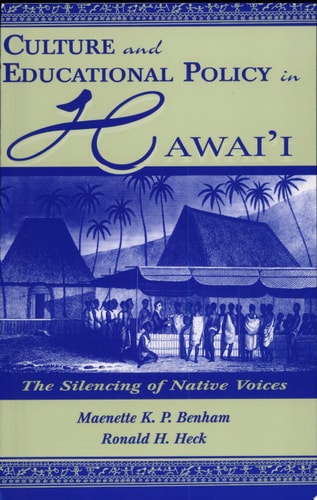
Culture and Educational Policy in Hawai'i: The Silencing of Native Voices
0
0
As an Amazon Associate and affiliate partner, Menrva Books earns from qualifying purchases. Learn more
Author Description
This comprehensive educational history of public schools in Hawai'i shows and analyzes how dominant cultural and educational policy have affected the education experiences of Native Hawaiians. Drawing on institutional theory as a scholarly lens, the authors focus on four historical cases representing over 150 years of contact with the West. They carefully link historical events, significant people, educational policy, and law to cultural and social consequences for Native Hawaiian children and youth. The authors argue that since the early 1800s, educational policy in Hawai'i emphasizing efficiency has resulted in institutional structures that have degenerated Hawaiian culture, self-image, and sovereignty. Native Hawaiians have often been denied equal access to quality schools and resulting increased economic and social status. These policies were often overtly, or covertly, racist and reflected wider cultural views prevalent across the United States regarding the assimilation of groups into the American mainstream culture. The case of education in Hawai'i is used to initiate a broader discussion of similar historical trends in assimilating children of different backgrounds into the American system of education. The scholarly analysis presented in this book draws out historical, political, cultural, and organizational implications that can be employed to understand other Native and non-Native contexts. Given the increasing cultural diversity of the United States and the perceived failure of the American educational system in light of these changes, this book provides an exceptionally appropriate starting point to begin a discussion about past, present, and future schooling for our nation's children. Because it is written and comes from a Native perspective, the value of the "insider" view is illuminated. This underlying reminder of the Native eye is woven throughout the book in Ha'awina No'ono'o--the sharing of thoughts from the Native Haw
Menrva's Summary
THE THESIS
This book investigates how dominant cultural and educational policies in Hawai'i have historically marginalized and silenced Native Hawaiian voices within the public school system. Drawing on institutional theory, the authors analyze over 150 years of educational history through four case studies, linking historical events, key figures, and legal frameworks to the cultural and social consequences for Native Hawaiian children. They argue that policies prioritizing efficiency have systematically undermined Hawaiian culture, self-image, and sovereignty, often rooted in racist assimilationist views prevalent across the United States. The work uses Hawai'i as a microcosm to discuss broader trends of cultural assimilation in American education, offering an 'insider' perspective from a Native viewpoint.
THE SCOPE MAP
- Analysis of dominant cultural and educational policy's impact on Native Hawaiian students.
- Application of institutional theory as a scholarly lens.
- Examination of four historical case studies spanning over 150 years.
- Linking of historical events, significant people, educational policy, and law to social consequences.
- Argument that efficiency-focused policies have degenerated Hawaiian culture, self-image, and sovereignty.
- Discussion of denied access to quality education and its link to economic and social status.
- Exploration of overtly and covertly racist policies reflecting assimilationist views.
- Broader discussion of similar historical trends in assimilating diverse children into the American education system.
THE AUTHORITY PERSPECTIVE
This book is presented as a critical examination of educational policy in Hawai'i, offering a Native Hawaiian perspective on the historical silencing of indigenous voices. The authors' use of institutional theory and detailed case studies aims to demonstrate the detrimental effects of assimilationist policies on Native Hawaiian culture and well-being. The work is positioned as a valuable resource for understanding broader issues of cultural diversity and educational equity in the United States, highlighting the importance of an 'insider' viewpoint in such analyses.
Page Count:
261
Publication Date:
1998-01-01
Publisher:
Psychology Press
ISBN-10:
0805827048
ISBN-13:
9780805827040
Non-Fiction
History
Sociology
Education
Community Tags
Similar Books





Reader Comments
Share Your Thoughts
No comments yet. Be the first to share your thoughts!