Tigris River History
0
0
As an Amazon Associate and affiliate partner, Menrva Books earns from qualifying purchases. Learn more
Author Description
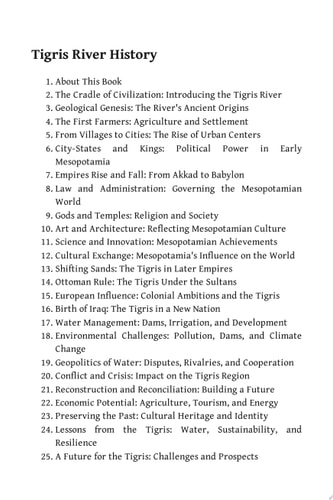
Tigris River History explores the profound role of the Tigris River in shaping Mesopotamian civilization and its lasting impact on world history. The book examines how this vital water source influenced the rise of agriculture and urban centers like Sumer and Akkad, and how it shaped the political and social structures of ancient Mesopotamia. By focusing on the river, the book offers a unique perspective on how natural resources can dictate the trajectory of entire civilizations. The narrative progresses chronologically, beginning with the river's geological origins and moving through the development of complex societies, empires, trade, warfare, and religious beliefs. For example, the book analyzes archaeological evidence of irrigation systems alongside historical accounts of water management policies. The book also delves into the river's significance in the modern era, exploring issues of water management, environmental challenges, and geopolitical tensions in contemporary Iraq, demonstrating the river's continuing relevance. Through an interdisciplinary approach, the book integrates insights from archaeology, history, geography, and political science. The book argues that the Tigris was not merely a geographical feature but an active agent in shaping the cultural, economic, and political landscape of Mesopotamia. The book draws upon archaeological findings, ancient texts, and contemporary scientific studies to provide a comprehensive and accessible account suitable for both academic readers and the general public.
Menrva's Summary
THE THESIS
The Tigris River served as a foundational element in the development and sustenance of Mesopotamian civilization, profoundly influencing its trajectory and leaving an indelible mark on world history. This book investigates how the Tigris River's presence shaped the rise of agriculture, the formation of urban centers like Sumer and Akkad, and the subsequent political and social structures of ancient Mesopotamia. By examining archaeological evidence of irrigation systems, historical accounts of water management, and integrating insights from archaeology, history, geography, and political science, the author argues that the river was an active agent in shaping the cultural, economic, and political landscape. The narrative progresses chronologically from the river's geological origins through its impact on empires, trade, warfare, and religious beliefs, extending to its modern relevance in issues of water management, environmental challenges, and geopolitical tensions in Iraq.
THE SCOPE MAP
- The geological origins and early development of the Tigris River.
- The influence of the Tigris on the rise of agriculture and early urban centers in Mesopotamia (Sumer, Akkad).
- The shaping of political and social structures by the river in ancient Mesopotamia.
- Analysis of irrigation systems and water management policies through archaeological evidence and historical accounts.
- The river's significance in trade, warfare, and religious beliefs of ancient empires.
- Contemporary issues of water management, environmental challenges, and geopolitical tensions in Iraq related to the Tigris.
- An interdisciplinary approach integrating archaeology, history, geography, and political science.
THE AUTHORITY PERSPECTIVE
The book offers a comprehensive and accessible account suitable for both academic readers and the general public, drawing upon archaeological findings, ancient texts, and contemporary scientific studies. Its interdisciplinary approach promises a rich understanding of the Tigris's role. The chronological progression from geological origins to modern geopolitical issues highlights the river's enduring significance. The central argument posits the Tigris not merely as a geographical feature but as an active force in shaping civilization.
Page Count:
62
Publication Date:
2025-02-12
Publisher:
Publifye AS
ISBN-10:
8233987824
ISBN-13:
9788233987824
History
Non-Fiction
Mesopotamia
Geography
Community Tags
Similar Books