Tiny Planet Patterns
0
0
As an Amazon Associate and affiliate partner, Menrva Books earns from qualifying purchases. Learn more
Author Description
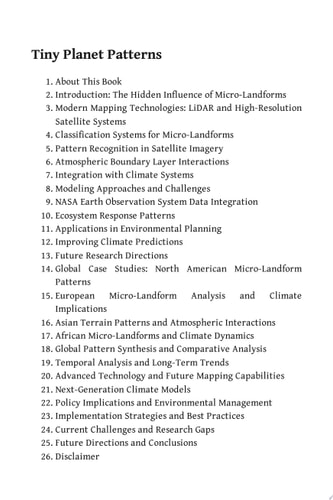
"Tiny Planet Patterns" explores the fascinating relationship between Earth's smallest landforms and global climate systems through advanced satellite technology and data analysis. This groundbreaking work demonstrates how microscale terrain features—those under 100 meters in size—play a crucial role in shaping climate patterns and ecosystem dynamics, challenging traditional modeling approaches that often overlook these small but significant elements. The book masterfully integrates cutting-edge remote sensing technology, including LiDAR and high-resolution satellite imagery, with sophisticated climate modeling techniques. By analyzing two decades of NASA Earth Observation System data, the research reveals how micro-landforms serve as essential variables in climate prediction models. The work presents compelling evidence that incorporating these small-scale features significantly improves forecasting accuracy, supported by multi-year satellite observations and field verification studies. Moving from detailed mapping methodologies to practical applications, the book progressively builds understanding through systematic examination of micro-landform categories and their atmospheric interactions. The interdisciplinary approach combines traditional geomorphological analysis with modern machine learning algorithms, making complex concepts accessible to earth science professionals, climate researchers, and advanced students. This unique integration of earth sciences, computer science, and atmospheric physics provides readers with comprehensive insights into surface-atmosphere interactions, ultimately contributing to more accurate environmental planning and climate predictions.
Menrva's Summary
THE THESIS
This book investigates the critical, yet often overlooked, role of Earth's smallest landforms in shaping global climate systems. The author, Leo Musk, leverages two decades of NASA satellite data and advanced analysis techniques, including LiDAR and high-resolution imagery, to demonstrate how microscale terrain features (under 100 meters) significantly influence climate patterns and ecosystem dynamics. By integrating traditional geomorphological analysis with modern machine learning algorithms, the work challenges existing climate modeling approaches, arguing for the inclusion of these micro-landforms to improve forecasting accuracy. The research is supported by multi-year satellite observations and field verification studies, offering a comprehensive view of surface-atmosphere interactions.
THE SCOPE MAP
- Analysis of micro-landforms (under 100 meters) and their impact on climate systems.
- Integration of advanced satellite technology (LiDAR, high-resolution imagery) and data analysis.
- Utilizes two decades of NASA Earth Observation System data.
- Demonstrates improved climate forecasting accuracy by incorporating micro-landform data.
- Combines traditional geomorphological analysis with machine learning algorithms.
- Explores practical applications for environmental planning and climate prediction.
- Focuses on surface-atmosphere interactions at a microscale level.
THE AUTHORITY PERSPECTIVE
This work presents a novel approach to climate modeling by focusing on micro-landforms, a subject typically overlooked in larger-scale analyses. The methodology, combining extensive satellite data with advanced analytical techniques, suggests a significant contribution to the field of earth and climate science. Its interdisciplinary nature, bridging geomorphology, computer science, and atmospheric physics, positions it as a valuable resource for researchers and students seeking to refine climate prediction models.
Page Count:
113
Publication Date:
2025-01-11
Publisher:
Publifye AS
ISBN-10:
8233943843
ISBN-13:
9788233943844
Science
Non-Fiction
Data Analysis
Earth Science
Geomorphology
Remote sensing
Environmental Planning
Community Tags
Similar Books