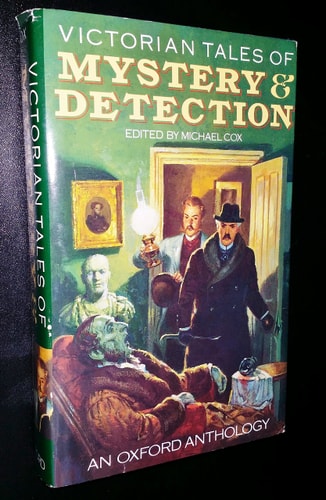
Victorian Tales of Mystery and Detection: An Oxford Anthology
0
0
As an Amazon Associate and affiliate partner, Menrva Books earns from qualifying purchases. Learn more
Author Description
The Victorian era saw the first great flowering of the detective story. Edgar Allen Poe, Charles Dickens, Wilkie Collins, Arthur Conan Doyle, J.S. LeFanu, and a host of others pioneered a genre of fiction that remains among the most popular today. Now, in Victorian Tales of Mystery and Detection, Michael Cox provides a sampling of the finest detective stories written from the 1840s to the early twentieth century.Here readers will find a vast array of detectives and villains, and a multitude of murder methods and motives. In Edgar Allen Poe's "The Purloined Letter," the identity of the robber is known from the start--it is the surreptitious retrieval of the letter that is the mystery. In M. McDonnell Bodkin's "Murder By Proxy," a gentleman is shot in the head at close range, by a murderer who was not even in the same room. Charles Dickens's "Hunted Down" portrays a murderer who was slowly poisoning his very own nieces for their insurance money. And in Sir Arthur Conan Doyle's "The Lost Special," a train and its passengers vanish in thin air. In addition, Cox (who is rapidly becoming one of the foremost experts on Victorian popular fiction) arranges the stories in chronological order so that readers can follow the genre as it develops over time. For instance, in Conan Doyle's "The Adventure of the Blue Carbuncle" we see an example of the many Sherlock Holmes escapades that popularized and came to typify the detective story for the Victorian public. And in the progression of the stories, we witness the evolution of the investigator from Poe's brilliant and eccentric Chevalier C. August Dupin, to Doyle's scientific Sherlock Holmes, into Robert Barr's cavalier Valmont (a possible model for Agatha Christie's Hercule Poirot).Including well-known stories by famous authors, as well as little known gems reprinted for the first time, Victorian Tales of Mystery and Detection not only offers hours of enjoyment and escape for all lovers of crime fiction, but also brings alive the
Menrva's Summary
THE PULSE
This anthology captures the emergence and evolution of the detective genre through a curated selection of Victorian-era narratives.
Michael Cox compiles a chronological progression of crime fiction, tracking the shift from early amateur sleuths to the rise of the professional investigator. The stories operate within the constraints of nineteenth-century social norms and early forensic logic, presenting a variety of puzzles ranging from locked-room mysteries to complex insurance fraud. The narrative framework shifts between the analytical brilliance of early protagonists and the more procedural, scientific approaches that defined the later Victorian period.
INSIDE THE PAGES
- Chronological arrangement of stories to demonstrate genre evolution
- Inclusion of foundational works by Edgar Allan Poe and Charles Dickens
- Representation of diverse investigative archetypes
- Focus on Victorian-era murder methods and criminal motives
- Mixture of widely recognized classics and rare, reprinted gems
- Exploration of the transition from eccentric genius to scientific detective
- Contextualization of the detective story as a popular cultural phenomenon
- Detailed examination of the structural development of the mystery plot
THE COLLECTIVE ECHO
Readers and critics frequently note the value of this anthology for its historical perspective on the development of crime fiction. Discussion often centers on the clear progression of the investigator archetype, moving from the intuitive methods of early characters to the more systematic approaches of later figures. Many appreciate the balance between well-known staples of the genre and the inclusion of lesser-known stories that provide a broader view of the era. The collection is often cited for its ability to demonstrate how Victorian authors established the tropes that continue to define modern detective fiction today. Readers highlight the chronological structure as a significant aid in understanding the maturation of the mystery form over several decades.
Page Count:
608
Publication Date:
1992-10-29
Publisher:
Oxford University Press
ISBN-10:
0192123084
ISBN-13:
9780192123084
Mystery
Detective
Anthology
Short Stories
Victorian
Classic Crime
Community Tags
Similar Books