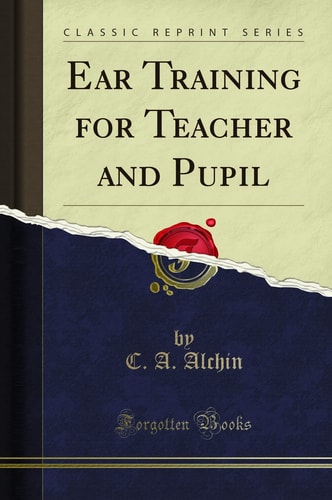
Ear Training for Teacher and Pupil
0
0
As an Amazon Associate and affiliate partner, Menrva Books earns from qualifying purchases. Learn more
Author Description
Excerpt from Ear Training for Teacher and Pupil The aim of this work is to teach the pupil to think in tones and to so train the ear and the feeling that even the tone-deaf may learn to sing, name, write and play what they hear; to harmonize melodies at sight, to improvise accompaniments, and to recognize and appreciate not only the melodic effects of music, but the harmonic and rhythmic as well. The voice cannot express what is not felt, and an idiot is the best proof of the fact that skill of hand Soes not reside in the hand alone, but in the mind. Discriminative hearing is indispensable to a musical education, and must precede or accompany all lines of study, that the lessons shall not be like those of a shop or manufactory, - a training of muscle only. Every tone in a key has its special character or color, a distinguishing melodic effect, aside from the pitch, which is the result of key relationship, and when the pupil perceives these distinctions he has the basis of harmony, which is the natural outgrowth of this system of ear-training. For the advantage of teachers and students who have a preference, both syllables and interval numbers are used in the exercises. The numbers i, 3, 5, etc., always refer to the degrees of the scale. If the syllables are used, it must be the old system of Movable Do, for this is a system not of absolute pitch, but of key relationship; the syllables representing not fixed sounds, but the tones of the scale, the names identical with the numbers. Different teachers have different uses for the syllables, and ours is to express key relationship only. About the Publisher Forgotten Books publishes hundreds of thousands of rare and classic books. Find more at www.forgottenbooks.com This book is a reproduction of an important historical work. Forgotten Books uses state-of-the-art technology to digitally reconstruct the work, preserving the original format whilst repairing impe
Menrva's Summary
THE THESIS
This work aims to develop a musician's ability to perceive, internalize, and reproduce musical tones and structures. The author, C. An Alchin, posits that aural discrimination is fundamental to musical education, preceding or accompanying practical study to ensure a holistic understanding beyond mere muscle memory. The text focuses on training the ear to recognize melodic, harmonic, and rhythmic elements, enabling students to not only sing and name pitches but also to improvise and appreciate the full spectrum of musical expression. It emphasizes the concept of 'key relationship' and the distinct character of each tone within a scale as the basis for harmonic understanding.
THE SCOPE MAP
- Exercises designed to train the ear to think in tones and recognize pitch relationships.
- Methods for the tone-deaf to learn to sing, name, write, and play music they hear.
- Techniques for harmonizing melodies at sight and improvising accompaniments.
- Analysis of melodic, harmonic, and rhythmic effects in music.
- Explanation of 'key relationship' and the character of tones within a scale.
- Use of both syllables (Movable Do) and interval numbers (1, 3, 5, etc.) in exercises.
- Focus on discriminative hearing as a prerequisite for musical education.
THE AUTHORITY PERSPECTIVE
This text is presented as a foundational work for music educators and students, emphasizing the critical role of ear training in developing musicality. The approach focuses on internalizing musical concepts through aural perception, aiming to equip learners with the ability to understand and reproduce music beyond rote memorization. The use of both solfège and numerical notation suggests a pedagogical method designed for clarity and adaptability across different learning preferences. The publisher's note indicates its status as a reproduction of a historically significant work, highlighting its enduring relevance in music education.
Page Count:
152
Publication Date:
2015-06-17
Publisher:
Fb&c Limited
ISBN-10:
1330338634
ISBN-13:
9781330338636
Music
Non-Fiction
Music theory
Music Education
Ear Training
Community Tags
Similar Books