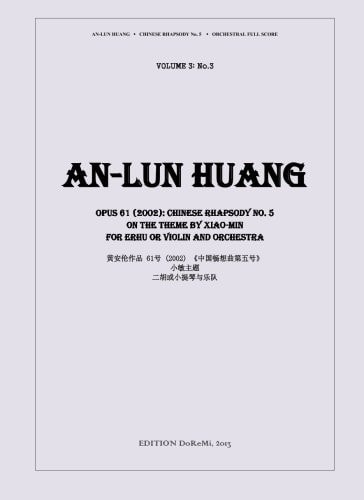
Chinese Rhapsody No. 5 On the Theme by Xiao-Min for Erhu Or Violin and Orchestra
0
0
As an Amazon Associate and affiliate partner, Menrva Books earns from qualifying purchases. Learn more
Author Description
Created by Franz Liszt, the rhapsody is such a music form in which folk tune and concert virtuosity are both constantly emphasized. Following his footprints, An-lun Huang's Chinese Rhapsodies are also especially effective in the tastes of different Chinese folk tunes. His most popular one is the "Chinese Rhapsody No.2", op.18. Not only did it become the official piece of numerous national piano competitions, it was also played by the Chinese pianist Lang Lang who performed this piece and won the 1st prize at the International Tchaikovsky Youth Piano Competition in 1994. This "Chinese Rhapsody No.5" is for the erhu, (a Chinese traditional instrument with only 2 strings), and orchestra. It is based on the original themes by Xiao Min, a village girl from the poor province of Henan, China.Both Xiao Min and her songs are a miracle of Chinese music. At only the level of grade 7, this peasant's little daughter received her limited education in a primary school of the small village. Nevertheless, without any training in music, she has created more than 1,100 songs (songs and texts), which have all been warmly received and sung alone by millions of Chinese people since the late 1990s.A symphonic music, the piece is structured into four parts. Performed continuously and combined with the popular hymn "Near the Cross " by William N.Doane, Xiao Min's songs are to be heard with all of the main themes of this Rhapsody.. The world premiere was performed by the Chinese erhu master George Gao with the Russian Philharmonic Orchestra under the baton of Tak-ng Lai in Moscow on the June of 2002. George Gao's brilliant interpretation and his dizzy-Pagagninian- typed-technique brought the erhu performing art into a brand new height. This piece has then became the official piece of the national Erhu competition of China.The Great Chinese violinist Huang Bin, the winner of the Gold plate of the International Paganini Violin competition, world premiered the violin version in Chicago in 2009,
Menrva's Summary
THE THESIS
of this work is to explore the fusion of traditional Chinese folk melodies with Western orchestral composition, specifically through the lens of An-Lun Huang's "Chinese Rhapsody No. 5".** The piece is structured into four continuous parts, drawing inspiration from the folk tunes of Xiao Min, a village girl from Henan, China, who composed over 1,100 songs despite limited education. Huang's rhapsody emphasizes both the folk origins and the virtuosic performance demands, following the tradition established by Franz Liszt. The work is presented in two versions: one for the erhu (a two-stringed Chinese instrument) and orchestra, and another for violin and orchestra, highlighting the adaptability of Xiao Min's themes.
THE SCOPE MAP
- What You Will Find:
- An orchestral composition based on folk themes by Xiao Min.
- A rhapsody structure emphasizing folk tunes and concert virtuosity.
- Two distinct performance versions: one for erhu and orchestra, and one for violin and orchestra.
- Integration of the popular hymn "Near the Cross" by William N. Doane.
- The original themes created by Xiao Min, a peasant composer from Henan.
- The world premiere performance details for the erhu version in Moscow, 2002.
- The world premiere performance details for the violin version in Chicago, 2009.
THE AUTHORITY PERSPECTIVE
This work is presented as a significant example of contemporary classical music that bridges Eastern and Western traditions, drawing on the compositional style of Franz Liszt. The description highlights the exceptional talent of Xiao Min, a village girl whose folk songs form the basis of the rhapsody, and the virtuosic interpretations by performers such as erhu master George Gao and violinist Huang Bin. Its adoption as an official piece for national Erhu competitions in China underscores its recognized artistic merit and technical demands.
Page Count:
112
Publication Date:
2013-08-11
Publisher:
CreateSpace Independent Publishing Platform
ISBN-10:
1492122416
ISBN-13:
9781492122418
Non-Fiction
Music
Folk Music
Violin Music
Community Tags
Similar Books