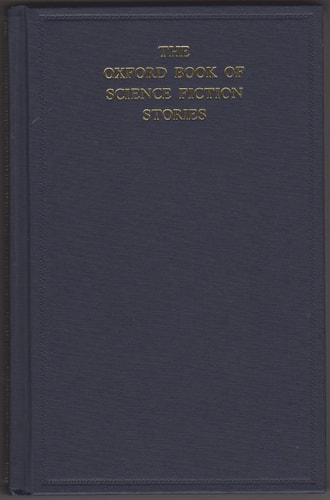
The Oxford Book of Science Fiction Stories
0
0
As an Amazon Associate and affiliate partner, Menrva Books earns from qualifying purchases. Learn more
Author Description
In "Swarm," Bruce Stirling takes the reader inside the Nest, a vast honeycomb of caverns within an asteroid orbiting Betelgeuse, peopled by hundreds of thousands of large, insectlike aliens, including eight-legged, furred workers the size of Great Danes, and horse-sized warriors with heavy, fanged heads. In "The Screwfly Solution," Raccoona Sheldon creates a world much like modern America, except that something--an insect virus, a mass religious delusion, or an alien--is infecting men worldwide, converting their sexual drive into homicidal rage against women. And J.G. Ballard in "Billennium" portrays the end result of unchecked population growth, a claustrophobic city of 30 million people, where by law the unmarried must live in cubicles four meters square. These three tales, though strikingly different, have one thing in common--each evokes a world that is uniquely the author's own. Indeed, to read any science fiction writer is to enter into another world. It may be a world far off in space or time, or it may be right here, right now, but with a twist--an invention, or event, or visitor--that suddenly changes everything.In The Oxford Book of Science Fiction Stories, Tom Shippey has brought together thirty classic science fiction tales, each of which offers a unique vision, an altered reality, a universe all its own. Here are some of the great names in science fiction--H.G. Wells, Arthur C. Clarke, Frederik Pohl, Brian Aldiss, Ursula K. Le Guin, Thomas Disch, Bruce Sterling, William Gibson, and David Brin. To give readers a sense of how the genre's range, vitality, and literary quality evolved over time, Shippey has organized these stories chronologically. Readers can sample H.G. Well's 1903 story "The Land Ironclads" (which predicted the stalemate of trench warfare and the invention of the tank), Jack Williamson's "The Metal Man," a rarely anthologized gem written in 1928, Clifford D. Simak's 1940s classic, "Desertion," set on "the howling maelstrom that was Jupite
Menrva's Summary
THE PULSE
This anthology presents a chronological selection of thirty science fiction stories that explore the evolution of the genre through diverse visions of altered realities. Each story functions as a self-contained narrative, presenting a unique world defined by specific technological, social, or biological shifts. The collection operates as a historical survey, moving from early twentieth-century speculative fiction to contemporary works, with each author establishing a distinct set of logical constraints and environmental conditions. The narrative frameworks vary widely, ranging from cautionary tales of societal collapse to explorations of extraterrestrial biology and future warfare.
INSIDE THE PAGES
- Chronological arrangement of stories to demonstrate genre evolution
- Inclusion of seminal works by H.G. Wells and Arthur C. Clarke
- Exploration of themes including population growth and technological warfare
- Diverse narrative perspectives from multiple decades of science fiction history
- Focus on world-building through specific inventions or events
- Inclusion of rare or less frequently anthologized pieces
- Examination of societal shifts and human behavior under pressure
- Varied stylistic approaches ranging from hard science fiction to social commentary
THE COLLECTIVE ECHO
Discussion often centers on the effectiveness of the chronological organization in highlighting the maturation of science fiction as a literary form. Readers frequently highlight the contrast between early technological predictions and later, more character-driven or sociological narratives. Critics note that the selection provides a balanced overview of the genre's range, successfully capturing both the technical ingenuity and the imaginative scope of the included authors. The anthology is often cited as a useful entry point for those seeking to understand the historical trajectory of speculative fiction through its most influential voices.
Page Count:
582
Publication Date:
1992-09-17
Publisher:
Oxford University Press
ISBN-10:
0192142046
ISBN-13:
9780192142047
Science Fiction
Speculative Fiction
Short Stories
Science Fiction
Anthology
Community Tags
Similar Books







Reader Comments
Share Your Thoughts
No comments yet. Be the first to share your thoughts!