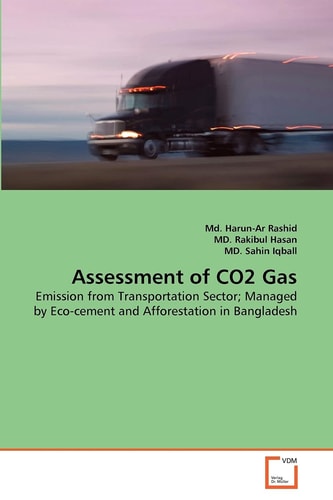
Assessment of CO2 Gas: Emission from Transportation Sector; Managed by Eco-cement and Afforestation in Bangladesh
0
0
As an Amazon Associate and affiliate partner, Menrva Books earns from qualifying purchases. Learn more
Author Description
Greenhouse gases (GHGs) are responsible for global warming and climate changes which absorb and emit radiation within the thermal infrared range. The aim of the study is to estimate emission of GHGs from transportation sector of BD. Afforestation required to absorb the emitted CO2 has also been predicted. Fossil fuel consumption data has been used for GHGs (CO2, CO, N2O, NOx, and CH4) emission estimation. Being a developing country BD is contributing GHGs in a very negligible rate. The transportation sector of BD is also less important sector in case of GHGs contributors. From this sector the major GHG is CO2. CO2 is the main GHG among all of the gases in transportation sector in BD and in 2005 the emission of CO2 is 7977Gg. CO is the second highest emitted GHGs in transportation sector in BD and in 2005 the emission of CO is about 253Gg. The emission of NOx is about 20.25Gg, CH4 is about 1.26Gg, N2O is about 0.15Gg. Estimated afforestation required to absorb CO2 emitted from transportation sector in the base year 2005 it required 1.15×10⁹m2 of afforestation. It is found that, 1 ton of concrete composed of eco-cement consume 180 Kg of CO2 in about 4-5 months.
Menrva's Summary
THE THESIS
This study quantifies greenhouse gas emissions from Bangladesh's transportation sector and estimates the afforestation required for CO2 absorption. The research utilizes fossil fuel consumption data to calculate emissions of CO2, CO, N2O, NOx, and CH4, noting Bangladesh's negligible contribution to global GHGs. It specifically identifies CO2 as the primary GHG from the transportation sector, with 7977 Gg emitted in 2005, followed by CO at 253 Gg. The study also projects the land area needed for afforestation to offset these emissions and introduces the CO2 consumption capacity of eco-cement.
THE SCOPE MAP
- Quantification of Greenhouse Gas (GHG) emissions from Bangladesh's transportation sector.
- Estimation of CO2, CO, N2O, NOx, and CH4 emissions based on fossil fuel consumption data.
- Prediction of the afforestation area required to absorb emitted CO2.
- Analysis of Bangladesh's contribution to global GHGs, noting its negligible rate.
- Identification of CO2 as the dominant GHG in the transportation sector.
- Specific emission figures for CO2 and CO in 2005.
- Calculation of required afforestation area in square meters for 2005 emissions.
- Inclusion of eco-cement's CO2 consumption capacity per ton of concrete.
THE AUTHORITY PERSPECTIVE
The study provides a detailed quantitative assessment of greenhouse gas emissions from Bangladesh's transportation sector, a critical aspect of environmental research for developing nations. It highlights the specific contributions of various gases and proposes tangible solutions like afforestation and the use of eco-cement. The research offers valuable data for policymakers and environmental scientists focused on climate change mitigation strategies within Bangladesh and similar economic contexts.
Page Count:
128
Publication Date:
2011-06-22
Publisher:
VDM Verlag Dr. Müller
ISBN-10:
3639365097
ISBN-13:
9783639365092
Science
Non-Fiction
Climate Change
Bangladesh
Transportation
Community Tags
Similar Books