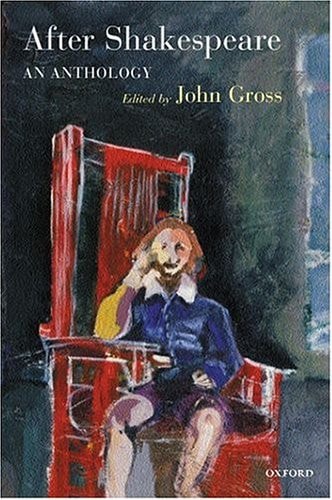
After Shakespeare: Writing Inspired by the World's Greatest Author
0
0
As an Amazon Associate and affiliate partner, Menrva Books earns from qualifying purchases. Learn more
Author Description
No writer has served as such a powerful source of inspiration for other writers, or attracted such varied and widespread comment, as William Shakespeare. From West Side Story, Ivan Turgenev's A Lear of the Steppes, Tom Stoppard's Rosencrantz & Guildenstern Are Dead to Polish poet Zbigniew Herbert's "Elegy for Fortinbras," Shakespeare's presence in literature and theater has been powerful and pervasive.Now, in After Shakespeare, editor John Gross brings together a lively gathering of writings that testify to that presence. More passionate and more personal than most Shakespeare criticism, these pieces reveal much more directly Shakespeare's effect on the generations of writers and thinkers who came after him. Novelists, poets, and playwrights are all represented, as one would expect. But Shakespeare's influence extends beyond the expected to philosophers, historians, composers, film-makers, and politicians. Here we see how Shakespearean characters and motifs fueled the genius of Goethe and Dostoevsky, Aldous Huxley and Emily Dickenson, John Updike and Duke Ellington, Marcel Proust and Grigor Kozintsev. We see Shakespeare the man firing the imaginations of Kipling, Joyce, Borges, and Burgess. Herman Melville writes a poem about Falstaff. D. H. Lawrence anatomizes Hamlet, (revealing much about his own aesthetic in the process). R. K. Narayan describes a Shakespeare lesson in an Indian classroom. John Osborne adapts Coriolanus. Eugene Ionescu reworks Macbeth. We even see Shakespeare's power to console the lonely prisoner in the writings of Alfred Dreyfus and Nelson Mandela.Wide-ranging, surprising, and written with refreshing immediacy, After Shakespeare brings together a collection of writings that not only reflects Shakespeare's enduring spirit but brilliantly embodies it.
Menrva's Summary
THE THESIS
This collection investigates the enduring and pervasive influence of William Shakespeare on the creative output and intellectual development of subsequent generations of writers, thinkers, and artists. Editor John Gross compiles a diverse array of personal essays, poems, and reflections to demonstrate how Shakespearean motifs and characters have functioned as a catalyst for global cultural production. By gathering perspectives from novelists, composers, and political figures, the text argues that Shakespeare serves as a foundational reference point that transcends traditional literary boundaries.
THE SCOPE MAP
What You Will Find
- A curated selection of writings from authors including Dostoevsky, Melville, Joyce, and Borges.
- Reflections on Shakespearean influence across diverse mediums such as film, music, and political discourse.
- Personal accounts of Shakespeare's impact on individuals in varied contexts, including classrooms and prisons.
Scope Limits
- The collection does not provide a comprehensive academic analysis of Shakespeare's original plays.
- It does not attempt to cover every instance of Shakespearean adaptation in modern media.
THE AUTHORITY PERSPECTIVE
Critics and readers frequently note the accessibility and personal tone of the essays, which contrast with more rigid academic critiques. Experts highlight this as a valuable resource for understanding the breadth of Shakespeare's cultural legacy across different historical and geographic contexts.
Page Count:
376
Publication Date:
2002-01-01
Publisher:
Oxford Univ. Press
ISBN-10:
0192142682
ISBN-13:
9780192142689
Literature
Cultural History
Anthology
Literary Criticism
Essays
Community Tags
Similar Books