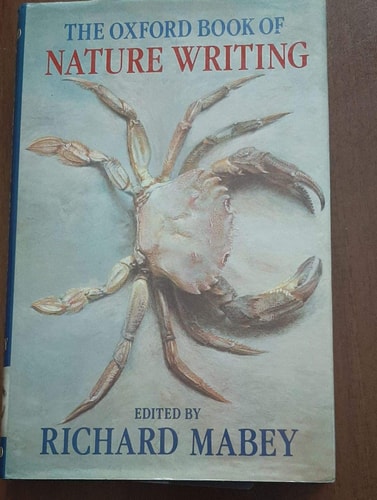
The Oxford Book of Nature Writing
0
0
As an Amazon Associate and affiliate partner, Menrva Books earns from qualifying purchases. Learn more
Author Description
"The Great Central Plain of California, during the months of March, April, and May, was one smooth, continuous bed of honey-bloom, so marvelously rich that, in walking from one end of it to the other, a distance of more than 400 miles, your foot would press about a hundred flowers at every step.... Sauntering in any direction, hundreds of these happy sun-plants brushed against my feet and closed over them as if I were wading in liquid gold. The air was sweet with fragrance, and larks sang their blessed songs, rising on the wing as I advanced, then sinking out of sight in the polleny sod, while myriads of wild bees stirred the lower air with their monotonous hum--monotonous, yet forever fresh and sweet as every-day sunshine." So wrote John Muir exactly one hundred years ago, in a passage that conveys not only the natural beauty of California, but also Muir's great love of the outdoors.In The Oxford Book of Nature Writing, John Mabey has brought together a sampler of some of the greatest writings on nature ever penned, in pieces that capture our endless fascination with the natural world. There are passages from ancient writers such as Aesop and Aristotle and Pliny, from the medieval manuscripts of Albertus Magnus, and from Anton van Leeuwenhoek's descriptions of microscopic animals. Mabey provides excerpts from the prose of the great Romantic writers, including Dorothy and William Wordsworth, Samuel Coleridge and William Hazlett, from the journals of Henry David Thoreau and from Jean-Jacques Rousseau's letters on botany, and from the naturalist writings of Charles Darwin, George Audubon, and Alexander von Humboldt. Perhaps most impressive is the gallery of contemporary nature writers represented here--a veritable who's who that includes excerpts from Barry Lopez's Arctic Dreams, Aldo Leopold's A Sand County Almanac, Loren Eiseley's The Immense Journey, Lewis Thomas's The Lives of a Cell, Bill McKibben's The End of Nature, and Annie Dillard's Pilgrim at Tinker Creek.
Menrva's Summary
THE THESIS
This anthology investigates the evolution of human observation and literary engagement with the natural world across centuries of written history. Richard Mabey, a noted naturalist and author, curates this collection to demonstrate how diverse cultural and scientific perspectives have shaped our understanding of the environment. By synthesizing voices from antiquity to the contemporary era, the book argues that nature writing serves as a critical bridge between empirical observation and philosophical reflection.
THE SCOPE MAP
What You Will Find
- A chronological survey of nature writing spanning from ancient Greek philosophers to modern environmental essayists.
- Excerpts from foundational scientific journals, medieval manuscripts, and Romantic-era prose.
- Representative selections from seminal works by authors such as Henry David Thoreau, Charles Darwin, Aldo Leopold, and Annie Dillard.
Scope Limits
- The collection does not provide a comprehensive history of environmental policy or political activism.
- It focuses primarily on Western literary traditions and does not offer an exhaustive global perspective on nature writing.
THE AUTHORITY PERSPECTIVE
Critics and readers frequently identify this volume as a foundational reference for those interested in the history of environmental literature. Scholars note the breadth of the selection, which effectively balances scientific observation with poetic interpretation.
Page Count:
272
Publication Date:
1995-05-04
Publisher:
Oxford University Press
ISBN-10:
0192141724
ISBN-13:
9780192141729
History
Nature
Natural History
Literature
Anthology
Essays
Nature
Environmental Writing
Community Tags
Similar Books