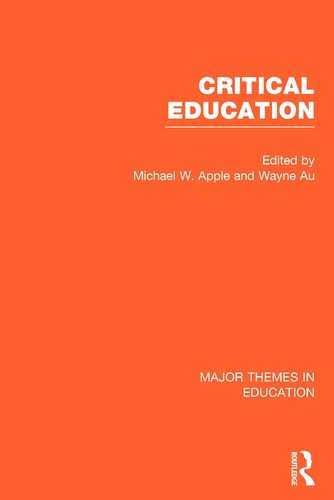
Critical Education: Major Themes in Education
0
0
As an Amazon Associate and affiliate partner, Menrva Books earns from qualifying purchases. Learn more
Author Description
Challenging and complex questions around inequality and power have been persistent within modern systems of education since their inception. But in the last four or five decades the vibrant field of critical education has developed and grown in response to such issues. Specifically, education scholars adopting a critical approach seek to interrogate how social, economic, cultural, linguistic, racial, sexual, and other forms of difference intersect and play out within school policy and classroom practices. Additionally, such scholars have shed light on the ways in which education can transform schools and society to be more just and radically democratic. The learned editors of this landmark Routledge Major Work collection argue that the field of critical education has become central within educational research. Most teacher-training programmes include courses that examine both the problems of inequality in education, and also how teachers and scholars can work to ameliorate those same problems. Moreover, the reach of critical educational research, policy, and practice is now truly international. The influence of these perspectives in Brazil and throughout Latin America, in part due to the work of Paulo Freire, is particularly striking. Powerful currents of critical education can also be found in Europe, Asia, and Africa. For example, entire states within India have based their efforts in school reform and the interruption of educationally driven inequalities around the principles of critical pedagogic and curricular traditions, arguments, and practices that have been enunciated in the literature. Another example can be found in China, where Beijing Normal University--which has the most influential school of education in China--has established a research centre in the name of the lead editor of this collection to document and spread the national and international influences of critical education. With the established and growing potency and influence of
Menrva's Summary
THE THESIS
This collection interrogates the persistent challenges of inequality and power within educational systems. The field of critical education, which has significantly developed over the past four to five decades, seeks to understand how social, economic, cultural, linguistic, racial, sexual, and other differences intersect within school policies and classroom practices. It also explores education's potential to foster more just and democratic societies. The editors highlight the field's centrality in contemporary educational research, its inclusion in teacher-training programs, and its growing international influence, particularly noting its impact in Latin America, Europe, Asia, and Africa.
THE SCOPE MAP
- Analysis of how social, economic, and cultural differences play out in schools.
- Exploration of education's role in transforming society towards justice and democracy.
- Examination of the historical development and growth of critical education as a field.
- Discussion of the international reach and influence of critical educational perspectives.
- Case studies and examples of critical education's impact in various global regions, including Latin America, India, and China.
- The role of critical pedagogy and curricular traditions in educational reform.
- The intersection of inequality, power, and educational policy and practice.
THE AUTHORITY PERSPECTIVE
The editors of this collection argue that critical education has become a central component of educational research, with its principles integrated into teacher-training programs and influencing educational reform globally. The collection aims to document and disseminate the national and international impact of critical education, drawing attention to its significant reach in regions like Latin America, India, and China. The work is presented as a landmark collection that consolidates key themes and debates within the field. Its influence is further underscored by the establishment of research centers dedicated to critical education, such as one named after the lead editor at Beijing Normal University.
Page Count:
1735
Publication Date:
2014-01-01
Publisher:
Routledge
ISBN-10:
0415687039
ISBN-13:
9780415687034
Non-Fiction
Economics
Politics
Education
Sociology Of Education
Educational Policy
Social justice
Community Tags
Similar Books