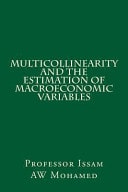
Multicollinearity and the Estimation of Macroeconomic Variables
0
0
As an Amazon Associate and affiliate partner, Menrva Books earns from qualifying purchases. Learn more
Author Description
The problem of multicollinearity in the assessments of coefficients is well established. However, it is rarely researched in the estimations of macroeconomic variables and economic performance of developing countries. Predicatively, it has impacts on the estimations of coefficients that should be used in economic decisions, strategic planning and if researchers are more industrious estimations of monetary supplies and demands. All such parameters are very basic and essential in economic planning and their applications should be done not only in research but in ground applications of the specialized authorities, e.g., Ministries of Finance, Central Banks, Pricing Units, etc. However, that is rarely done and when carried out, the estimators can be inefficient, misestimated or have statistic problems such as multicollinearity, auto-regressions or homoscedacity. All the former lead to mis-interpretations of the statistical and econometric results and if used in any of above-mentioned parameters can be erroneous. Wrong and misinterpreted coefficients, reversed signals or incorrect significance levels are expected. Thus using such coefficients is useless and lead to bad decisions. Truly, macroeconomic variables usually have correlations with each with variable degrees. However, the latter shows the erroneous estimations only when tested. The current text book focuses on building-up models for macroeconomic variables of Sudan with the possibilities that they have the multicollinearity problem. In the analysis the Ordinary Least Squares method is used besides the Ridge Regression to estimate the equations. The analysis revealed that there are multicollinearity when the production and consumption functions were estimated. However, investment, liquidity functions and monetary equilibrium did not have that problem. We recommend here that the utilization of OLS in the estimation can be beneficial and reliable.
Menrva's Summary
THE THESIS
This book investigates the impact of multicollinearity on the estimation of macroeconomic variables, particularly within the context of developing countries like Sudan. The author, Prof. Issam Aw Mohamed, addresses the established problem of multicollinearity and its under-researched implications for economic performance assessments. The text focuses on building models for Sudan's macroeconomic variables, employing Ordinary Least Squares (OLS) and Ridge Regression to identify and address potential estimation inefficiencies that could lead to erroneous economic decisions and misinterpretations of statistical results.
THE SCOPE MAP
- Analysis of multicollinearity in macroeconomic variable estimations.
- Case study focusing on the economic variables of Sudan.
- Application of Ordinary Least Squares (OLS) and Ridge Regression methods.
- Identification of multicollinearity in production and consumption functions.
- Assessment of investment, liquidity functions, and monetary equilibrium.
- Recommendations for the utilization of OLS in estimation for reliability.
THE AUTHORITY PERSPECTIVE
The book addresses a critical issue in econometric analysis, particularly relevant for developing economies where data limitations and interdependencies can exacerbate multicollinearity. The author's focus on Sudan provides a specific empirical context for understanding these challenges. The application of both OLS and Ridge Regression offers a comparative approach to estimation. The findings regarding the presence of multicollinearity in certain functions and its absence in others highlight the nuanced nature of econometric modeling.
Page Count:
200
Publication Date:
2013-09-12
Publisher:
CreateSpace Independent Publishing Platform
ISBN-10:
1492715425
ISBN-13:
9781492715429
Economics
Non-Fiction
Sudan
Econometrics
Developing Countries
Community Tags
Similar Books