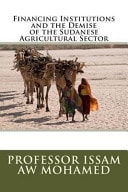
Financing Institutions and the Demise of the Sudanese Agricultural Sector
0
0
As an Amazon Associate and affiliate partner, Menrva Books earns from qualifying purchases. Learn more
Author Description
The document describes reasons for the degeneration of the Sudanese agriculture with reference on its financing mechanism. It is not an exaggeration to surmise that agriculture as an economic activity in Sudan is facing demise. The agricultural sector of Sudan has been facing by many problems for the past two decades. In the irrigated schemes, the government who officially owns most of them there were entrenched managerial problems that brewed for more than six decades. Moreover, the privatization policies of those schemes provoked many outcries and protests and undeclared strikes manifested in non-productive or walk out. Large schemes like Gezira have collapsed with the predation of its infrastructure, i.e., inner railways, crops processing plants, irrigation and machinery departments. This year 2012, only 10% of its over one million hectares were cultivated. The rainfed farming is not different in the characteristic low productivity with lack of chicaneries, shortages of available labor and high priced agricultural inputs. It is did not fare better fate than the irrigated schemes. However, even if those problems were solved the main chronic impediment remains which are manifested in appropriate financing, e.g., lower interest rates, availability and accessibility which remain unsolved. The paper discusses the formal financing issues for the agriculture in Sudan. Empirical analysis is carried out which showed that there are problems in the previously described parameters, interest rates, availability and accessibility. The first, even with Islamic financing forms, there were high interest rates on loans. The second, availability showed that the current financing institutions have problems, specially financing with the banking branches and possible collaterals. Accessibility to finance remains a difficult task, because after the privatization and desertion of the official administration and finance, only large-size landholders have the privilege.
Menrva's Summary
THE THESIS
The central problem investigated is the systemic failure of financing mechanisms to support and revitalize Sudan's agricultural sector, leading to its widespread degeneration. The paper, authored by Issam Mohamed and Prof Issam Aw Mohamed, examines the multifaceted issues plaguing Sudanese agriculture over the past two decades, including managerial problems in irrigated schemes and the disruptive effects of privatization. It highlights the collapse of major schemes like Gezira and the persistent low productivity in rainfed farming due to factors like labor shortages and high input costs. Ultimately, the analysis focuses on the chronic impediments of inappropriate financing, specifically addressing high interest rates (even within Islamic financing), limited availability of funds, and the inaccessibility of credit, particularly for smaller landholders post-privatization.
THE SCOPE MAP
- Analysis of managerial problems in government-owned irrigated agricultural schemes.
- Impact of privatization policies on agricultural schemes, including protests and strikes.
- Detailed examination of the collapse of large schemes such as Gezira, including infrastructure degradation.
- Assessment of low productivity in rainfed farming, citing chicaneries, labor shortages, and high input costs.
- Empirical analysis of financing issues: interest rates, availability, and accessibility.
- Discussion of high interest rates on loans, even within Islamic financing frameworks.
- Evaluation of financing availability, focusing on banking branches and collateral requirements.
- Exploration of accessibility challenges, noting the privilege of large landholders post-privatization.
THE AUTHORITY PERSPECTIVE
This analysis of Sudan's agricultural financing challenges is presented as a critical examination of systemic economic failures. The authors detail the historical context of managerial issues and the disruptive impact of privatization, suggesting a deep-seated problem that predates current financial mechanisms. The empirical findings underscore persistent issues with interest rates, availability, and accessibility of credit, particularly for smaller farmers. The work aims to provide a clear-eyed view of the impediments to agricultural recovery in Sudan.
Page Count:
92
Publication Date:
2013-05-07
Publisher:
CreateSpace Independent Publishing Platform
ISBN-10:
1491272244
ISBN-13:
9781491272244
Economics
Non-Fiction
Agriculture
Community Tags
Similar Books










Reader Comments
Share Your Thoughts
No comments yet. Be the first to share your thoughts!