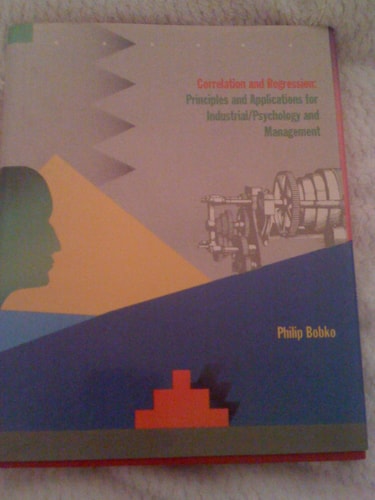
Correlation and Regression: Principles and Applications for Industrial/Organizational Psychology and Management
0
0
As an Amazon Associate and affiliate partner, Menrva Books earns from qualifying purchases. Learn more
Author Description
The goal of this book is to take statistical theory in correlation and regression and make it accessible to readers using words, equations, and a variety of applied examples (which help explain how the techniques work and under what circumstances some creativity in application is necessary). The book's goal is practical, and the tone is commonsensical. These objectives reflect the underlying philosophy that the application of correlation and regression techniques are not necessarily straightforward, and require thinking about each technique in creative ways.The first half of the book covers topics in correlation (calculating and interpreting r, hypothesis testing of correlations, applications in measurement, the effects of range restriction, etc.). The second half of the book is devoted to regression topics (parameter estimates in bivariate and multivariate regression, distribution theory, applications to utility analysis, polynomials, interactions, validity shrinkage, etc.). Within each chapter, examples are provided which practitioners of science will undoubtedly encounter in some form or another. While some chapters cover the traditional topics in regression and correlation, other chapters in this book are written entirely as examples of applications issues. This makes the book unique. Chapter IV is devoted to the ubiquitous problem of "measurement" in the social sciences and how correlations help us to better assess scientific phenomena. Chapter V is devoted to the problem of "range restriction." It is a common fact of life, yet no other book devotes the necessary space to this critical problem. Chapter VII is specifically focused on applications of bivariate regression (e.g., regression to the mean; utility analysis). Finally, Chapters IX and X give more extended coverage of interactive models and validity shrinkage (two very important issues) than you will find in other regression books.
Menrva's Summary
THE THESIS
This text investigates the practical application of correlation and regression statistical techniques within the specific context of industrial/organizational psychology and management. Philip Bobko, an expert in the field, bridges the gap between abstract statistical theory and real-world application by utilizing a commonsensical approach. The book argues that statistical analysis in the social sciences is rarely straightforward and requires practitioners to apply creative, context-aware thinking to their data models.
THE SCOPE MAP
What You Will Find
- Comprehensive coverage of correlation, including hypothesis testing and measurement applications.
- Detailed examination of regression, covering bivariate and multivariate models, polynomials, and interaction effects.
- Specialized analysis of range restriction, utility analysis, and validity shrinkage.
- Applied examples tailored to common challenges faced by organizational scientists.
Scope Limits
- The text does not provide a general introduction to statistics for non-specialists.
- It does not cover advanced machine learning or non-parametric statistical methods.
THE AUTHORITY PERSPECTIVE
Experts and practitioners frequently cite this work for its unique focus on the specific application issues inherent in organizational research. Readers often note that the prose balances technical rigor with a practical, accessible tone suitable for graduate students and professionals.
Page Count:
283
Publication Date:
1995-01-01
Publisher:
McGraw-Hill College
ISBN-10:
0070062234
ISBN-13:
9780070062238
Psychology
Data Analysis
Medical Books
New Used & Rental Textbooks
Mathematics
Research Methods
Science & Math
Psychology
Statistics
Management
Counseling Psychology
Industrial Psychology
Community Tags
Similar Books