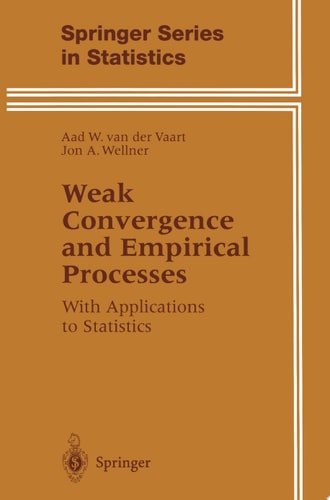
Weak Convergence and Empirical Processes With Applications to Statistics
0
0
As an Amazon Associate and affiliate partner, Menrva Books earns from qualifying purchases. Learn more
Author Description
This book tries to do three things. The first goal is to give an exposition of certain modes of stochastic convergence, in particular convergence in distribution. The classical theory of this subject was developed mostly in the 1950s and is well summarized in Billingsley (1968). During the last 15 years, the need for a more general theory allowing random elements that are not Borel measurable has become well established, particularly in developing the theory of empirical processes. Part 1 of the book, Stochastic Convergence, gives an exposition of such a theory following the ideas of J. Hoffmann-J!1Jrgensen and R. M. Dudley. A second goal is to use the weak convergence theory background devel oped in Part 1 to present an account of major components of the modern theory of empirical processes indexed by classes of sets and functions. The weak convergence theory developed in Part 1 is important for this, simply because the empirical processes studied in Part 2, Empirical Processes, do naturally viewed as taking values in nonseparable Banach spaces, even in the most elementary cases, and are typically not Borel measurable. Much of the theory presented in Part 2 has previously been scattered in the journal literature and has, as a result, been accessible only to a relatively small number of specialists. In view of the importance of this theory for statis tics, we hope that the presentation given here will make this theory more accessible to statisticians as well as to probabilists interested in statistical applications.
Menrva's Summary
THE THESIS
This book investigates the theory of weak convergence and its application to empirical processes in statistics. The authors, Aad van der Vaart and Jon Wellner, aim to provide a comprehensive exposition of stochastic convergence, particularly convergence in distribution, extending classical theories to accommodate random elements in nonseparable Banach spaces. This theoretical foundation is then applied to the modern theory of empirical processes, which are crucial for statistical analysis but often not Borel measurable. The book seeks to make this advanced material, previously scattered in journals, more accessible to statisticians and probabilists.
THE SCOPE MAP
- An exposition of stochastic convergence, including convergence in distribution, with extensions for non-Borel measurable random elements.
- An account of major components of the modern theory of empirical processes indexed by classes of sets and functions.
- Application of weak convergence theory to empirical processes, particularly those taking values in nonseparable Banach spaces.
- A presentation of material previously accessible only to specialists, aiming to broaden its reach within the statistical and probabilistic communities.
THE AUTHORITY PERSPECTIVE
The book is recognized as a significant contribution to the field, providing a unified and accessible treatment of weak convergence and empirical processes. Its detailed exposition of advanced topics, previously dispersed in specialized literature, is intended to serve as a valuable resource for statisticians and probabilists. The authors' aim to make this complex theory more approachable is a key aspect of its reception. The text is structured to build from foundational concepts of stochastic convergence to their application in empirical process theory.
Page Count:
510
Publication Date:
2013-03-09
Publisher:
Springer Science & Business Media
ISBN-10:
1475725450
ISBN-13:
9781475725452
Science
Non-Fiction
Probability
Mathematics
Statistics
Community Tags
Similar Books