Synthetic Applications of the Thermolysis of Benzamidoxime Derivatives: Synthesis and Thermolysis of Benzamidoxime Derivatives
0
0
As an Amazon Associate and affiliate partner, Menrva Books earns from qualifying purchases. Learn more
Author Description
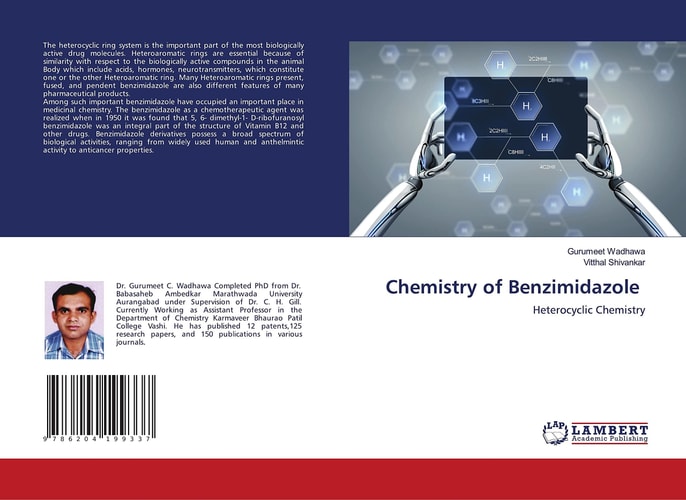
Over the last few years, the classic synthesis of benzimidazoles has low yields and through complex routes. In the past thirty years organic thermochemistry has developed rapidly and led to a wealth of novel reactions and applications that can be of great significance. The present work has been devoted to study of thermal fragmentation of aromatic and heterocyclic amidoximes I-VI at 220-240oC alone and /or in the presence of naphthalene and tetralin as radical scavengers. The main feature of these thermolyses is the homolysis of the N-O and C-N bonds initiating different free radical reactions. These studies have been led to the formation of novel synthesis of a variety of heterocyclic compounds like; benzimidazole derivatives as the major products (45-60 %) in addition to benzoxazoles, carbazoles and triazine as the minor products. such reactions in an effort to gain further information about more generalized thermolytic mechanism to account for the identified products. In addition to the aimed synthetic value of the work, mechanistic studies and environmental applications are also targeted.
Menrva's Summary
THE THESIS
This work investigates the thermal fragmentation of aromatic and heterocyclic amidoximes to develop novel synthetic routes for heterocyclic compounds. The study focuses on the thermolysis of specific amidoxime derivatives (I-VI) at temperatures between 220-240°C, both independently and in the presence of radical scavengers like naphthalene and tetralin. The primary mechanism involves the homolysis of N-O and C-N bonds, initiating free radical reactions that lead to the formation of benzimidazole derivatives as major products (45-60%), alongside minor amounts of benzoxazoles, carbazoles, and triazines. The research aims to elucidate a generalized thermolytic mechanism and explore the synthetic, mechanistic, and environmental applications of these reactions.
THE SCOPE MAP
- Detailed study of the thermal fragmentation of aromatic and heterocyclic amidoximes (compounds I-VI).
- Investigation of thermolysis reactions at temperatures ranging from 220-240°C.
- Analysis of reactions conducted alone and in the presence of radical scavengers (naphthalene, tetralin).
- Identification of major products, primarily benzimidazole derivatives (45-60% yield).
- Identification of minor products including benzoxazoles, carbazoles, and triazines.
- Elucidation of reaction mechanisms driven by N-O and C-N bond homolysis.
- Exploration of synthetic applications for novel heterocyclic compounds.
- Consideration of mechanistic studies and potential environmental applications.
THE AUTHORITY PERSPECTIVE
This research presents a focused study on the thermolytic synthesis of heterocyclic compounds, particularly benzimidazoles. The methodology employs established thermochemical principles and radical scavenging techniques to analyze reaction pathways and product distributions. The work contributes to the understanding of organic reaction mechanisms and offers potential for novel synthetic strategies in heterocyclic chemistry.
Page Count:
140
Publication Date:
2014-01-01
Publisher:
Lap Lambert Academic Publishing GmbH KG
ISBN-10:
3659533157
ISBN-13:
9783659533150
Science
Non-Fiction
Chemical synthesis
Organic chemistry
Heterocyclic Compounds
Community Tags
Similar Books