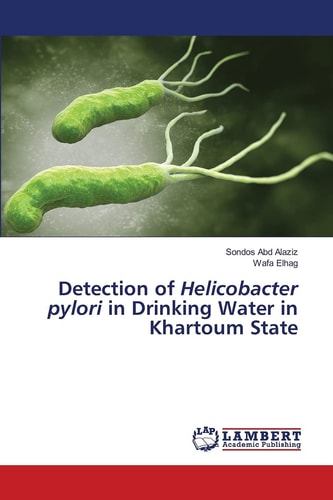
Detection of Helicobacter pylori in Drinking Water in Khartoum State
0
0
As an Amazon Associate and affiliate partner, Menrva Books earns from qualifying purchases. Learn more
Author Description
Helicobacter pylori causes gastritis and peptic ulcers in millions of people around the world, it has also been involved in stomach cancer to such a level that WHO has classified it as a Class I Carcinogen. In Sudan, information about the prevalence of Helicobacter pylori infection is very patchy, one of the studies showed high prevalence (80%) of Helicobacter pylori among patients with symptoms of gastritis, 56% with duodenal ulcer, and 16% apparently look normal. A study was conducted study was to assess bacteriological, physical, and chemical quality of drinking water distributed at Khartoum metropolitan state, in order to ascertain water quality for human consumption showed that all treated tap water samples (100%) were positive for bacterial contamination. The seriousness of Helicobacter pylori infection with the high prevalence rate and the suggestion of many studies that Helicobacter pylori can transmitted by contaminated water and with early mentioned high rate of water contamination in Khartoum state, this is study aimed to investigate the presence of Helicobacter pylori in drinking water in Khartoum state.
Menrva's Summary
THE THESIS
This study investigates the presence of Helicobacter pylori in drinking water within Khartoum State, Sudan, a region with limited data on the bacterium's prevalence and known issues with water contamination. The research aims to address the significant public health concern posed by Helicobacter pylori, a pathogen linked to gastritis, peptic ulcers, and stomach cancer, by examining drinking water sources in Khartoum. Given the high reported rates of bacterial contamination in the area's treated tap water and the known transmission routes of H. pylori via water, this study is crucial for understanding potential exposure pathways and informing public health strategies.
THE SCOPE MAP
- Assessment of bacteriological, physical, and chemical quality of drinking water in Khartoum metropolitan state.
- Investigation into the presence and prevalence of Helicobacter pylori in various drinking water sources.
- Analysis of water contamination levels in relation to H. pylori transmission.
- Contribution to understanding the patchy information on H. pylori infection rates in Sudan.
- Evaluation of drinking water safety for human consumption in the studied region.
THE AUTHORITY PERSPECTIVE
The study addresses a critical public health issue concerning the prevalence of Helicobacter pylori in drinking water in Khartoum State, a region with known water contamination challenges. By investigating the presence of this carcinogen in water sources, the research aims to fill a gap in existing knowledge about H. pylori transmission routes in Sudan. The findings are expected to inform public health initiatives and water quality management strategies within the metropolitan area. The study's focus on bacteriological, physical, and chemical parameters provides a comprehensive view of water safety for consumption.
Page Count:
52
Publication Date:
2021-03-09
Publisher:
LAP LAMBERT Academic Publishing
ISBN-10:
6203461717
ISBN-13:
9786203461718
Science
Non-Fiction
Water Quality
Public Health
Medical research
Microbiology
Community Tags
Similar Books