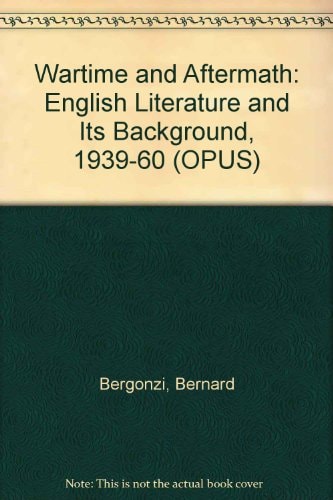
Wartime and Aftermath: English Literature and its Background 1939-1960
0
0
As an Amazon Associate and affiliate partner, Menrva Books earns from qualifying purchases. Learn more
Author Description
This new survey of the writers of the wartime and postwar period reveals how literature in Britain was affected by the most devastating war in history, how it engaged with public events and private feelings during the fighting and throughout the long aftermath of recovery. Drawing on a rich variety of sources, Bernard Bergonzi discusses the work of such writers as Graham Greene, Elizabeth Bowen, Evelyn Waugh, and Joyce Cary, and the immense popularity of T. S. Eliot, Dylan Thomas, and other poets during the war years. He also provides a full examination of the new literary figures who emerged in the wake of the conflict, including Angus Wilson, Philip Larkin, Iris Murdoch, and William Golding.
Menrva's Summary
THE THESIS
This book investigates how the geopolitical and social trauma of World War II and its subsequent recovery period fundamentally reshaped the thematic and stylistic trajectory of British literature between 1939 and 1960. Bernard Bergonzi, a noted scholar of 20th-century literature, utilizes a combination of historical context and critical analysis to map the evolution of the British literary landscape. He argues that the war acted as a catalyst for both established authors and a new generation of writers, forcing a re-evaluation of public duty and private identity in a post-conflict society.
THE SCOPE MAP
What You Will Find
- Analysis of major literary figures including Graham Greene, Evelyn Waugh, and Iris Murdoch.
- Examination of the shift in poetic popularity during the war years, focusing on T. S. Eliot and Dylan Thomas.
- Discussion of the emergence of post-war novelists such as Philip Larkin and William Golding.
Scope Limits
- The text focuses primarily on British authors and does not provide an exhaustive survey of international or Commonwealth literature from the same period.
- The analysis concludes at 1960 and does not address the subsequent shifts in postmodernism or the late 20th-century literary movements.
THE AUTHORITY PERSPECTIVE
Scholars and students of 20th-century British literature frequently cite this work as a reliable and comprehensive overview of the mid-century transition. Readers often note the academic density of the prose, which serves as a foundational text for those studying the intersection of historical events and literary output.
Page Count:
330
Publication Date:
1993-05-27
Publisher:
Oxford University Press
ISBN-10:
0192192426
ISBN-13:
9780192192424
History
War stories
Criticism history
20th Century
Literary Criticism
British literature
Community Tags
Similar Books