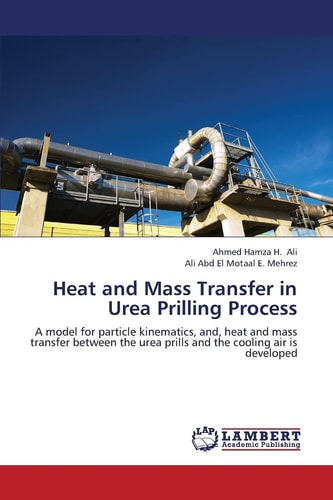
Heat and Mass Transfer in Urea Prilling Process
0
0
As an Amazon Associate and affiliate partner, Menrva Books earns from qualifying purchases. Learn more
Author Description
Urea prills are produced in the prilling tower, where a cooling-solidification-cooling process of the prills takes place. The ambient air is used as the cooling stream for this process. A case study of the urea prilling process is chosen due to in hot/humid days, the temperature of the product at the bottom of the prilling tower is hot and cannot be packed directly. In addition, the urea prills form lumps and cakes with each other on the scrubber at the bottom of the prilling tower that affects the quality of the product. A mathematical model based on the particle kinematics, and, heat and mass transfer between the urea prills and the cooling air is developed. This is followed by using a numerical technique with an explicit scheme to solve the model. The model numerical results are validated with Scanning Electronic Microscope (SEM) observation of urea particles. Moreover, to investigate the effect of the urea prilling tower configuration parameters on the above urea product problems, the hydrodynamic of air flow inside the tower is analyzed using Computational Fluid Dynamics (CFD) simulation software.
Menrva's Summary
THE THESIS
This study investigates the critical heat and mass transfer phenomena occurring during the urea prilling process to address product quality issues. The research focuses on the cooling-solidification-cooling stages within a prilling tower, utilizing ambient air as the cooling medium. It addresses problems such as high product temperature on hot, humid days and the formation of lumps and cakes, which degrade product quality. A mathematical model is developed, incorporating particle kinematics and heat/mass transfer, solved using a numerical explicit scheme and validated against SEM observations, while CFD simulations analyze air flow dynamics to optimize tower configuration.
THE SCOPE MAP
- A mathematical model for heat and mass transfer in urea prilling, considering particle kinematics.
- Numerical solution using an explicit scheme.
- Validation of numerical results with Scanning Electronic Microscope (SEM) observations of urea particles.
- Computational Fluid Dynamics (CFD) simulation to analyze air flow hydrodynamics within the prilling tower.
- Investigation into the effect of prilling tower configuration parameters on product quality issues.
THE AUTHORITY PERSPECTIVE
This technical paper presents a detailed engineering analysis of the urea prilling process, focusing on the physical and chemical transformations that occur. The methodology combines mathematical modeling with numerical simulation and experimental validation, suggesting a rigorous approach to understanding and optimizing industrial processes. The work appears to be aimed at chemical engineers and process specialists seeking to improve product quality and operational efficiency in urea production.
Page Count:
120
Publication Date:
2013-01-01
Publisher:
Lap Lambert Academic Publishing GmbH KG
ISBN-10:
3659345067
ISBN-13:
9783659345067
Non-Fiction
Science
Fluid dynamics
Process Engineering
Thermodynamics
Chemical Engineering
Community Tags
Similar Books