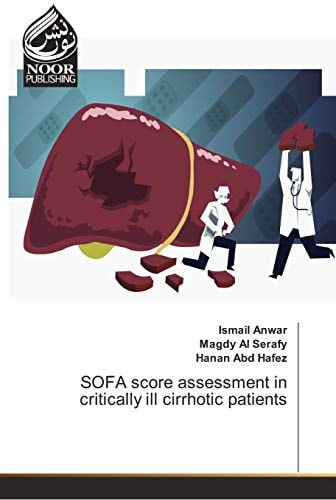
SOFA Score Assessment in Critically Ill Cirrhotic Patients
0
0
As an Amazon Associate and affiliate partner, Menrva Books earns from qualifying purchases. Learn more
Author Description
Cirrhotic patients admitted to the intensive care unit (ICU) have poor prognosis; with mortality rates ranging from 34 to 69%.Discrimination of cirrhotic patients who will maximally benefit from ICU admission is greatly cost effective given the often limited ICU resources. For this, several prognostic models are being used for comparison and quality assessment in different intensive care units. Two types of such models can be used in cirrhotic patients: general prognostic models, those evaluating severity of illness, namely the Acute Physiology and Chronic Health Evaluation (APACHE) II and Simplified Acute Physiology Score (SAPS) II; and those quantifying organ dysfunction and failure as Sequential Organ Failure Assessment (SOFA) score, and disease-specific models as Child-Pugh score and Model for End-Stage Liver Disease (MELD) score. This study aims at prospective evaluation of the efficacy of the SOFA score in comparison with liver specific scoring system (CTP and MELD) in predicting the outcome of critically ill cirrhotic patients admitted to the ICU for prioritization of high risk patients and preservation of ICU resources.
Menrva's Summary
THE THESIS
This study investigates the predictive efficacy of the Sequential Organ Failure Assessment (SOFA) score in critically ill cirrhotic patients admitted to the ICU. The research aims to compare the SOFA score against liver-specific scoring systems, namely the Child-Pugh (CTP) and Model for End-Stage Liver Disease (MELD) scores, to determine their effectiveness in predicting patient outcomes. By evaluating these prognostic models, the study seeks to aid in the prioritization of high-risk patients and the efficient allocation of limited ICU resources, addressing the poor prognosis and high mortality rates associated with cirrhosis in critical care settings.
THE SCOPE MAP
- Prospective evaluation of the SOFA score's efficacy in critically ill cirrhotic patients.
- Comparative analysis of SOFA score against CTP and MELD scores for outcome prediction.
- Assessment of prognostic models for prioritization of high-risk patients in the ICU.
- Discussion on the cost-effectiveness of prognostic models given limited ICU resources.
THE AUTHORITY PERSPECTIVE
The study evaluates established prognostic models for critically ill cirrhotic patients, focusing on the SOFA score's utility in comparison to liver-specific systems like CTP and MELD. The research is framed within the context of high mortality rates and the need for resource optimization in intensive care units for this patient population. The methodology appears to be a prospective evaluation, aiming to provide data that can inform clinical decision-making regarding patient prioritization and resource allocation.
Page Count:
164
Publication Date:
2017-01-01
Publisher:
Noor Publishing
ISBN-10:
3330967870
ISBN-13:
9783330967878
Science
Non-Fiction
Critical Care
Hepatology
Medical research
Community Tags
Similar Books