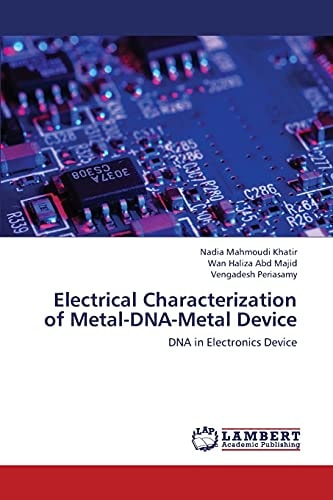
Electrical Characterization of Metal-DNA-Metal Device DNA in Electronics Device
0
0
As an Amazon Associate and affiliate partner, Menrva Books earns from qualifying purchases. Learn more
Author Description
Recently, Deoxyribonucleic Acid (DNA) has become an interesting candidate for conduction of electrical current. The outcome could be useful in nanotechnology and nanoelectronics for the design of electrical circuits, which could in turn help to overcome the limitations that classical silicon (Si)-based electronics would be facing in coming years.The utilization of DNA in electronic device such as micro and nano sensors in recent years has increased. High throughput micro array sensors in biotechnology applications and medical diagnosis, MEMS and NEMS opens up new windows for utilization of DNA based sensors.
Menrva's Summary
THE THESIS
This work investigates the potential of Deoxyribonucleic Acid (DNA) as a material for conducting electrical current in electronic devices. The authors explore DNA's application in nanotechnology and nanoelectronics, aiming to address the limitations of current silicon-based technologies. The research focuses on metal-DNA-metal devices and their utility in sensors for biotechnology and medical diagnosis, as well as in micro and nanoelectromechanical systems (MEMS and NEMS).
THE SCOPE MAP
- Exploration of DNA's electrical conduction properties.
- Application of DNA in nanotechnology and nanoelectronics.
- Design of electrical circuits using DNA.
- Overcoming limitations of silicon-based electronics.
- Utilization of DNA in electronic devices such as micro and nano sensors.
- High throughput micro array sensors in biotechnology applications.
- DNA-based sensors for medical diagnosis.
- Integration of DNA in MEMS and NEMS.
THE AUTHORITY PERSPECTIVE
This publication appears to be a technical report or a specialized academic study focusing on the emerging field of DNA-based electronics. The subject matter suggests a dense, research-oriented text aimed at specialists in materials science, electrical engineering, and nanotechnology. The detailed examination of metal-DNA-metal devices indicates a focus on the fundamental electrical characteristics and potential applications within advanced sensor technologies and miniaturized electronic systems. The work likely contributes to the ongoing exploration of novel conductive materials beyond traditional semiconductors.
Page Count:
76
Publication Date:
2013-01-01
Publisher:
Lap Lambert Academic Publishing GmbH KG
ISBN-10:
3659432784
ISBN-13:
9783659432781
Non-Fiction
Science
Science & Technology
Electronics
Biotechnology
Nanotechnology
Community Tags
Similar Books