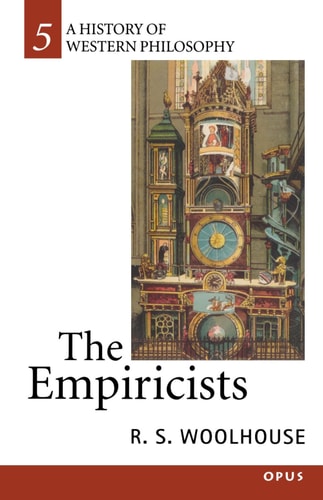
The Empiricists
0
0
As an Amazon Associate and affiliate partner, Menrva Books earns from qualifying purchases. Learn more
Author Description
One of the great historic controversies in philosophy," according to Bertrand Russell, is that between empiricists--"best represented by the British philosophers, Locke, Berkeley, and Hume"--and rationalists. This book sets the empiricists in their contemporary and cultural context, examinestheir various approaches to philosophy, and highlights the significance of their ideas to 20th-century thinking. By focusing on what the "empiricists" actually have to say, rather than on their classification as such, Woolhouse incidentally shows how unreliable these conventional labels canbe.
Menrva's Summary
THE THESIS
This work investigates the core tenets and historical impact of the British empiricist tradition, questioning the utility of the rigid 'empiricist' label in philosophical discourse. R. S. Woolhouse, a scholar of early modern philosophy, utilizes a contextual approach to analyze the primary texts of John Locke, George Berkeley, and David Hume. By examining their specific arguments rather than relying on historical generalizations, the author demonstrates how these thinkers shaped the trajectory of Western thought and influenced subsequent 20th-century philosophical developments.
THE SCOPE MAP
What You Will Find
- Detailed analysis of the philosophical systems of Locke, Berkeley, and Hume
- Contextualization of 17th and 18th-century British intellectual culture
- Critical evaluation of the rationalist versus empiricist dichotomy
- Exploration of the legacy of empiricism in modern analytical philosophy
Scope Limits
- Does not provide an exhaustive biography of the philosophers
- Excludes detailed comparative analysis of non-Western philosophical traditions
THE AUTHORITY PERSPECTIVE
Experts frequently cite this volume as a precise and accessible entry point for students seeking to understand the nuances of early modern British philosophy. Readers often note that the prose maintains a high level of academic rigor while successfully challenging conventional historical classifications.
Page Count:
192
Publication Date:
1988-03-31
Publisher:
Oxford University Press
ISBN-10:
0192192078
ISBN-13:
9780192192073
Philosophy
Non-Fiction
Philosophy history
Empiricism
British Empiricism
Epistemology