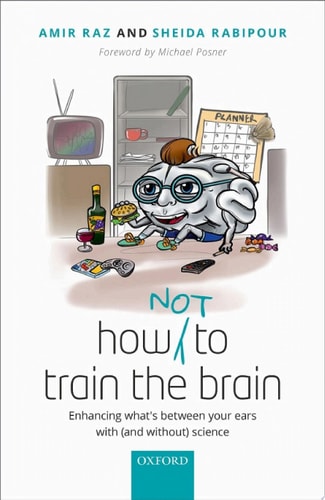
How (Not) to Train the Brain: Enhancing What's Between Your Ears With (and Without) Science
0
0
As an Amazon Associate and affiliate partner, Menrva Books earns from qualifying purchases. Learn more
Author Description
Brain training is all the rage. Commercial and clinical initiatives capitalize on trailblazing interdisciplinary research that spans domains such as education, psychological and brain science, cognitive remediation, and mental health. Promotional materials boast that we can learn to think and respond faster, focus better, and control our emotions; companies and authors market techniques to boost memory, increase confidence, and overcome cognitive impairments. 'How (not) to Train the Brain' examines the field of cognitive fitness and scrutinizes the scientific evidence in support of brain training techniques. With the potential to affect millions this topic is important for scientists, practitioners, educators, and the general public. While many a consumer often marvels at this highly commercialized field, discerning fact from fad becomes a challenge given the abundance of products, publications, and contexts. Moreover, available products prey on the naivety of individuals unfamiliar with the nuanced field of neuroscience, advertising programs that lack scientific validation or presenting unfounded arguments. In this book, the authors review data from hundreds of articles and provide an overarching account of the field, separating scientific evidence from publicity myth and guiding readers through how they should - and should not - train the brain. They describe existing techniques, including those rooted in scientific research, and survey methods that purport to yield measurable improvements. Intended for a wide audience, this book taps a timely topic by highlighting the most salient approaches to boosting brain function while identifying those that don't seem to work.
Menrva's Summary
THE THESIS
This book investigates the validity of commercial brain training programs by distinguishing evidence-based cognitive enhancement from unsubstantiated marketing claims. The authors, both experts in cognitive neuroscience and psychology, synthesize data from hundreds of peer-reviewed articles to evaluate the efficacy of various mental fitness techniques. They provide a critical framework for readers to assess whether specific brain training methods offer genuine cognitive benefits or merely capitalize on consumer interest in mental optimization.
THE SCOPE MAP
What You Will Find
- Analysis of cognitive remediation and mental health interventions
- Evaluation of commercial brain training products and their scientific backing
- Examination of psychological and brain science research regarding neuroplasticity
Scope Limits
- Does not provide a step-by-step manual for personal cognitive improvement
- Does not cover non-scientific or purely anecdotal wellness practices outside the scope of cognitive fitness
THE AUTHORITY PERSPECTIVE
Experts in the field of neuroscience recognize this work as a necessary corrective to the proliferation of unverified cognitive enhancement products. Readers frequently note the academic rigor of the authors' approach, which serves as a reliable guide for navigating the complex intersection of commercial marketing and clinical brain science.
Page Count:
371
Publication Date:
2019-01-01
Publisher:
OUP Oxford
ISBN-10:
0192506811
ISBN-13:
9780192506818
Non-Fiction
Psychology
Science
Health
Neuroscience
Self Help
Community Tags
Similar Books