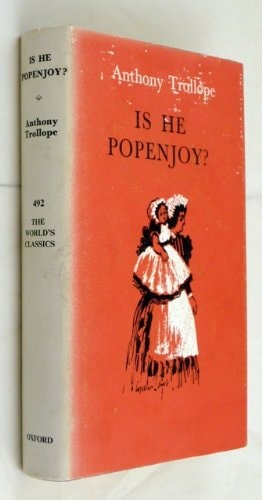
Is He Popenjoy?
0
0
As an Amazon Associate and affiliate partner, Menrva Books earns from qualifying purchases. Learn more
Author Description
Anthony Trollope ( 24 April 1815 – 6 December 1882) was an English novelist of the Victorian era. Among his best-known works is a series of novels collectively known as the Chronicles of Barsetshire, which revolves around the imaginary county of Barsetshire. He also wrote novels on political, social, and gender issues, and other topical matters. Trollope's literary reputation dipped somewhat during the last years of his life,but he had regained the esteem of critics by the mid-20th century. Biography: Thomas Anthony Trollope, Anthony's father, was a barrister. Though a clever and well-educated man and a Fellow of New College, Oxford, he failed at the bar due to his bad temper. In addition, his ventures into farming proved unprofitable, and he lost an expected inheritance when an elderly childless uncle remarried and had children. As a son of landed gentry, he wanted his sons to be raised as gentlemen and to attend Oxford or Cambridge. Anthony Trollope suffered much misery in his boyhood owing to the disparity between the privileged background of his parents and their comparatively small means.Born in London, Anthony attended Harrow School as a free day pupil for three years from the age of seven because his father's farm, acquired for that reason, lay in that neighbourhood. After a spell at a private school at Sunbury, he followed his father and two older brothers to Winchester College, where he remained for three years. He returned to Harrow as a day-boy to reduce the cost of his education. Trollope had some very miserable experiences at these two public schools. They ranked as two of the most élite schools in England, but Trollope had no money and no friends, and was bullied a great deal. At the age of twelve, he fantasised about suicide. However, he also daydreamed, constructing elaborate imaginary worlds. In 1827, his mother Frances Trollope moved to America with Trollope's three younger siblings, to Nashoba Commune. After that failed, she opened a bazaar in Cincinnati, which proved unsuccessful. Thomas Trollope joined them for a short time before returning to the farm at Harrow, but Anthony stayed in England throughout. His mother returned in 1831 and rapidly made a name for herself as a writer, soon earning a good income. His father's affairs, however, went from bad to worse. He gave up his legal practice entirely and failed to make enough income from farming to pay rents to his landlord, Lord Northwick. In 1834, he fled to Belgium to avoid arrest for debt. The whole family moved to a house near Bruges, where they lived entirely on Frances's earnings. In Belgium, Anthony was offered a commission in an Austrian cavalry regiment. To accept it, he needed to learn French and German; he had a year in which to acquire these languages. To learn them without expense to himself and his family, he took a position as an usher (assistant master) in a school in Brussels, which position made him the tutor of thirty boys. After six weeks of this, however, he received an offer of a clerkship in the General Post Office, obtained through a family friend. He returned to London in the autumn of 1834 to take up this post.Thomas Trollope died the following year. According to Trollope, "the first seven years of my official life were neither creditable to myself nor useful to the public service." At the Post Office, he acquired a reputation for unpunctuality and insubordination. A debt of £12 to a tailor fell into the hands of a moneylender and grew to over £200; the lender regularly visited Trollope at his work to demand payments. Trollope hated his work, but saw no alternative and lived in constant fear of dismissal.
Menrva's Summary
THE PULSE
The sudden return of the Marquis of Brotherton with an Italian wife and a young son triggers a bitter legal and social dispute over the legitimacy of the heir and the succession of the family estate. Lord George Germain, the heir presumptive, finds his life and financial stability upended by the arrival of his brother, the Marquis, whose erratic behavior and questionable marriage cast doubt on the status of the young Popenjoy. As the family navigates the rigid social hierarchies of Victorian England, Lord George must balance his personal integrity against the pressures of his wife, Mary, and the intrusive scrutiny of high society. The narrative employs a third-person omniscient perspective to dissect the motivations of the landed gentry, focusing on the intersection of inheritance law and domestic morality. The conflict intensifies as the legitimacy of the child becomes a public spectacle, forcing the characters to confront the consequences of their social standing and private choices.
INSIDE THE PAGES
- Detailed exploration of Victorian inheritance laws and property rights
- Satirical portrayal of high-society manners and social climbing
- Examination of the tension between traditional aristocratic values and modern sensibilities
- Character-driven narrative focusing on the psychological development of the Germain family
- Use of irony to highlight the absurdity of social conventions
- Intricate dialogue that reveals character motivations and hidden agendas
- Realistic depiction of the domestic sphere and its influence on public reputation
- Pacing that mirrors the slow, methodical nature of legal and social maneuvering
THE COLLECTIVE ECHO
Readers frequently highlight the novel's sharp wit and its ability to expose the hypocrisies inherent in the Victorian class system. Discussion often centers on the character of Mary Germain, whose development from a naive young woman to a resilient figure provides a grounding force amidst the legal chaos. Critics often note that while the plot revolves around a specific inheritance dispute, the true focus remains on the interpersonal dynamics and the moral compromises made by the characters. The pacing is often described as deliberate, allowing for a thorough examination of the social pressures that dictate the lives of the landed gentry. Many readers appreciate the balance between the serious legal stakes and the lighter, satirical elements that define the author's signature style.
Page Count:
648
Publication Date:
1973-01-01
Publisher:
Oxford Univ Pr
ISBN-10:
0192504924
ISBN-13:
9780192504920
Realism
Victorian
classic
Domestic fiction
Social Satire
Community Tags
Other Editions(8)





Similar Books





Reader Comments
Share Your Thoughts
No comments yet. Be the first to share your thoughts!