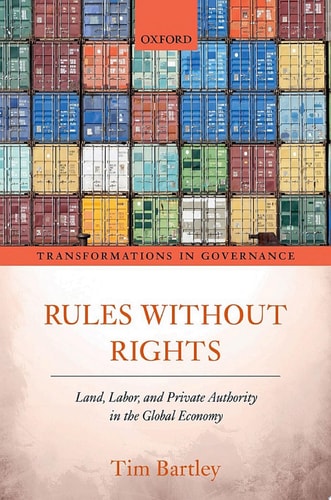
Rules without Rights: Land, Labor, and Private Authority in the Global Economy
0
0
As an Amazon Associate and affiliate partner, Menrva Books earns from qualifying purchases. Learn more
Author Description
Activists have exposed startling forms of labor exploitation and environmental degradation in global industries, leading many large retailers and brands to adopt standards for fairness and sustainability. This book is about the idea that transnational corporations can push these standards through their global supply chains, and in effect, pull factories, forests, and farms out of their local contexts and up to global best practices. For many scholars and practitioners, this kind of private regulation and global standard-setting can provide an alternative to regulation by territorially-bound, gridlocked, or incapacitated nation states, potentially improving environments and working conditions around the world and protecting the rights of exploited workers, impoverished farmers, and marginalized communities. But can private, voluntary standards actually create meaningful forms of regulation? Are forests and factories around the world actually being made into sustainable ecosystems and decent workplaces? Can global norms remake local orders? This book provides striking new answers by comparing the private regulation of land and labor in democratic and authoritarian settings. Case studies of sustainable forestry and fair labour standards in Indonesia and China show not only how transnational standards are implemented 'on the ground' but also how they are constrained and reconfigured by domestic governance. Combining rich multi-method analyses, a powerful comparative approach, and a new theory of private regulation, Rules without Rights reveals the contours and contradictions of transnational governance. Transformations in Governance is a major new academic book series from Oxford University Press. It is designed to accommodate the impressive growth of research in comparative politics, international relations, public policy, federalism, environmental and urban studies concerned with the dispersion of authority from central states up to supranational institutions, down to
Menrva's Summary
THE THESIS
This book investigates whether private, voluntary standards imposed by transnational corporations can effectively regulate labor and environmental practices within global supply chains. Tim Bartley, a scholar of sociology and organizational studies, utilizes a comparative framework to analyze how global norms interact with local governance structures. By examining the implementation of sustainability and labor standards, the author argues that domestic political contexts significantly constrain and reconfigure the efficacy of these private regulatory efforts.
THE SCOPE MAP
What You Will Find
- Comparative analysis of sustainable forestry and fair labor standards in Indonesia and China.
- A theoretical framework for understanding the interaction between transnational private regulation and domestic governance.
- Multi-method research combining qualitative case studies with broader institutional analysis.
Scope Limits
- The study focuses primarily on the intersection of private regulation and state governance rather than providing a comprehensive manual for corporate social responsibility implementation.
- It does not cover every industry sector, focusing instead on specific examples of land and labor regulation.
THE AUTHORITY PERSPECTIVE
Scholars in political science and international relations identify this work as a rigorous examination of the limitations inherent in private governance models. Readers frequently note the academic density of the prose, which provides a nuanced look at how global standards are filtered through local political realities.
Page Count:
365
Publication Date:
2018-01-01
Publisher:
OUP Oxford
ISBN-10:
0192513109
ISBN-13:
9780192513106
Economics
Labor Studies
International relations
International business
Governance
Agriculture
Globalization
Employee rights
Community Tags
Similar Books