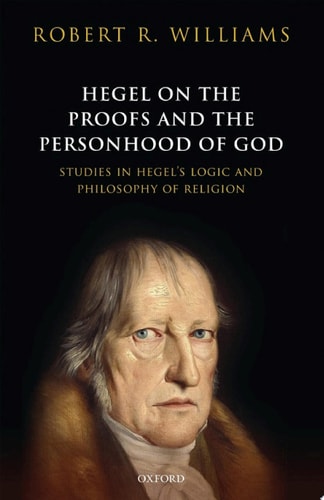
Hegel on the Proofs and the Personhood of God: Studies in Hegel's Logic and Philosophy of Religion
0
0
As an Amazon Associate and affiliate partner, Menrva Books earns from qualifying purchases. Learn more
Author Description
Hegel's analysis of his culture identifies nihilistic tendencies in modernity i.e., the death of God and end of philosophy. Philosophy and religion have both become hollowed out to such an extent that traditional disputes between faith and reason become impossible because neither any longer possesses any content about which there could be any dispute; this is nihilism. Hegel responds to this situation with a renewal of the ontological argument (Logic) and ontotheology, which takes the form of philosophical trinitarianism. Hegel on the Proofs and the Personhood of God examines Hegel's recasting of the theological proofs as the elevation of spirit to God and defense of their content against the criticisms of Kant and Jacobi. It also considers the issue of divine personhood in the Logic and Philosophy of Religion. This issue reflects Hegel's antiformalism that seeks to win back determinate content for truth (Logic) and the concept of God. While the personhood of God was the issue that divided the Hegelian school into left-wing and right-wing factions, both sides fail as interpretations. The center Hegelian view is both virtually unknown, and the most faithful to Hegel's project. What ties the two parts of the book together-Hegel's philosophical trinitarianism or identity as unity in and through difference (Logic) and his theological trinitarianism, or incarnation, trinity, reconciliation, and community (Philosophy of Religion)-is Hegel's Logic of the Concept. Hegel's metaphysical view of personhood is identified with the singularity (Einzelheit) of the concept. This includes as its speculative nucleus the concept of the true infinite: the unity in difference of infinite/finite, thought and being, divine-human unity (incarnation and trinity), God as spirit in his community.
Menrva's Summary
THE THESIS
This work investigates how Hegel’s Logic and Philosophy of Religion provide a coherent response to the nihilistic tendencies of modernity through a renewal of the ontological argument and a defense of divine personhood. Robert A. Williams Jr. utilizes a rigorous analysis of Hegel’s primary texts to argue that the philosopher’s project is best understood through his concept of philosophical trinitarianism. By examining the intersection of the Logic of the Concept and theological doctrines, the author challenges the traditional left-wing and right-wing interpretations of Hegel’s work, proposing instead a central Hegelian view that emphasizes unity in and through difference.
THE SCOPE MAP
What You Will Find
- An examination of Hegel’s recasting of theological proofs against Kantian and Jacobi-based criticisms.
- A detailed analysis of the Logic of the Concept as the unifying framework for Hegel’s metaphysical and theological systems.
- A discussion on the singularity of the concept as it relates to divine personhood and the true infinite.
Scope Limits
- The text does not provide a general introduction to Hegelian philosophy for lay readers.
- It does not focus on the political or social implications of Hegel’s work outside of the context of his theological and metaphysical framework.
THE AUTHORITY PERSPECTIVE
Scholars and students of German Idealism frequently note the high level of academic density and technical precision required to engage with this text. Experts highlight this work as a significant contribution to the study of Hegel’s theological project, particularly for its attempt to move beyond the binary of left-wing and right-wing Hegelian interpretations.
Page Count:
333
Publication Date:
2017-01-01
Publisher:
OUP Oxford
ISBN-10:
0192514687
ISBN-13:
9780192514684
Religion
Philosophy
Metaphysics
Theology
Community Tags
Similar Books