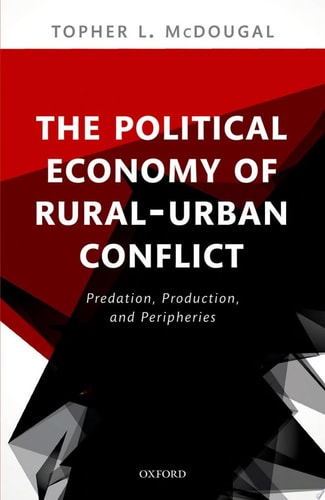
The Political Economy of Rural-Urban Conflict
0
0
As an Amazon Associate and affiliate partner, Menrva Books earns from qualifying purchases. Learn more
Author Description
In some cases of insurgency, the combat frontier is contested and erratic, as rebels target cities as their economic prey. In other cases, it is tidy and stable, seemingly representing an equilibrium in which cities are effectively protected from violent non-state actors. What factors account for these differences in the interface between urban-based states and rural-based challengers? To explore this question, this volume examines two regions representing two dramatically different outcomes. In West Africa (Liberia and Sierra Leone), capital cities became economic targets for rebels, who posed dire threats to the survival of the state. In Maoist India, despite an insurgent ideology aiming to overthrow the state via a strategy of progressive city capture, the combat frontier effectively firewalls cities from Maoist violence. This book argues that trade networks underpinning the economic relationship between rural and urban areas - termed 'interstitial economies' - may differ dramatically in their impact on (and response to) the combat frontier. It explains rebel predatory tendencies towards cities as a function of transport networks allowing monopoly profits to be made by urban-based traders. It explains combat frontier delineation as a function of the social structure of the trade networks: hierarchical networks permit elite-elite bargains that cohere the frontier. These factors represent what might be termed respectively the 'hardware' and 'software' of the rural-urban economic relationship. Of interest to any student of political economy and violence, this book presents new arguments and insights about the relationships between violence and the economy, predation and production, core and periphery.
Menrva's Summary
THE THESIS
What factors account for the variation in how rural-based insurgents interact with urban-based states, specifically regarding whether cities become targets of predation or remain protected by stable combat frontiers? Topher L. McDougal investigates the economic underpinnings of conflict by analyzing the relationship between rural and urban areas. He proposes that 'interstitial economies'—the trade networks connecting these regions—dictate the nature of violence. By examining the 'hardware' of transport networks and the 'software' of social structures, the author argues that these economic configurations determine whether rebels prey upon cities or are contained by elite-level bargains.
THE SCOPE MAP
What You Will Find
- Comparative analysis of conflict dynamics in West Africa (Liberia and Sierra Leone) versus Maoist India.
- Theoretical framework defining 'interstitial economies' as a driver of conflict geography.
- Examination of how transport networks and monopoly profits influence rebel behavior.
- Analysis of social hierarchies and elite-elite bargaining in maintaining combat frontiers.
Scope Limits
- The study focuses primarily on the specific regions of West Africa and India, rather than providing a global survey of all rural-urban conflicts.
- The analysis does not extensively cover non-economic motivations for insurgency, such as purely ideological or ethnic drivers.
THE AUTHORITY PERSPECTIVE
Scholars in political economy and security studies identify this work as a rigorous contribution to the understanding of how economic infrastructure shapes the geography of war. Readers frequently note the analytical clarity with which the author bridges the gap between micro-level trade networks and macro-level state stability.
Page Count:
192
Publication Date:
2017-01-01
Publisher:
Oxford University Press
ISBN-10:
019251119X
ISBN-13:
9780192511195
Economics
Sociology
International relations
Conflict Studies
Community Tags
Similar Books