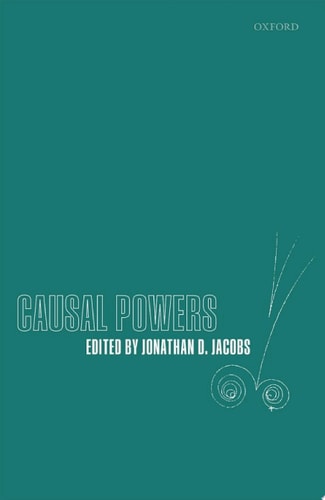
Causal Powers
0
0
As an Amazon Associate and affiliate partner, Menrva Books earns from qualifying purchases. Learn more
Author Description
Causal powers are ubiquitous. Electrons are negatively charged; they have the power to repel other electrons. Water is a solvent; it has the power to dissolve salt. We use concepts of causal powers and their relatives-dispositions, capacities, abilities, and so on-to describe the world around us, both in everyday life and in scientific practice. But what is it about the world that makes such descriptions apt? On one view, the neo-Humean view, there is nothing intrinsic about, say, negative charge, that makes its bearers have the power to repel other negatively charged particles. Rather, matters extrinsic to negative charge, the patterns and regularities in which negatively charged particles are embedded, fix the powers its bearers have. But on a different view, the anti-Humean view, causal powers are intrinsically powerful, bringing with them their own causal, nomic, and modal nature independent of extrinsic patterns and regularities-even fixing those patterns and regularities. This collection brings together new and important work by both emerging scholars and those who helped shape the field on the nature of causal powers, and the connections between causal powers and other phenomena within metaphysics, philosophy of science, and philosophy of mind. Contributors discuss how one who takes causal powers to be in some sense irreducible should think about laws of nature, scientific practice, causation, modality, space and time, persistence, and the metaphysics of mind.
Menrva's Summary
THE THESIS
This collection investigates the ontological status of causal powers and whether they are intrinsically powerful or dependent upon extrinsic patterns and regularities. Jonathan D. Jacobs compiles a series of essays from both established and emerging scholars to address the debate between neo-Humean and anti-Humean perspectives. The text examines how the concept of irreducible causal powers influences our understanding of laws of nature, scientific practice, and the fundamental structure of reality.
THE SCOPE MAP
What You Will Find
- Analysis of the neo-Humean versus anti-Humean debate regarding causal properties.
- Discussions on the intersection of causal powers with modality, space, and time.
- Philosophical inquiries into the metaphysics of mind and persistence.
- Theoretical frameworks for interpreting scientific practice through the lens of dispositionalism.
Scope Limits
- The text does not provide a singular, unified theory of causation but rather presents a variety of competing academic viewpoints.
- It does not focus on empirical scientific data but remains strictly within the domain of analytical metaphysics.
THE AUTHORITY PERSPECTIVE
Experts identify this collection as a significant contribution to contemporary metaphysical discourse, particularly for those engaged in the study of properties and laws of nature. Readers frequently note the academic density of the prose, which is intended for advanced students and professional philosophers.
Page Count:
256
Publication Date:
2017-01-01
Publisher:
OUP Oxford
ISBN-10:
0192516604
ISBN-13:
9780192516602
Philosophy
Mind & Body
Metaphysics
Causation
Philosophy of
Academic