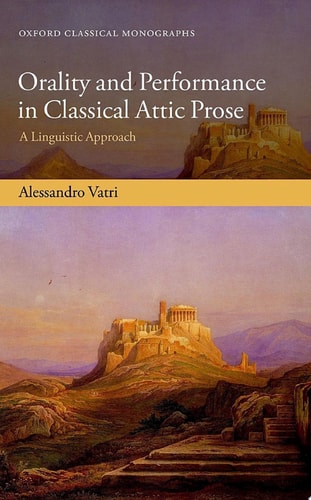
Orality and Performance in Classical Attic Prose: A Linguistic Approach
0
0
As an Amazon Associate and affiliate partner, Menrva Books earns from qualifying purchases. Learn more
Author Description
This study discusses the question of whether there is a linguistic difference between classical Attic prose texts intended for public oral delivery and those intended for written circulation and private performance. Identifying such a difference which exclusively reflects these disparities in modes of reception has proven to be a difficult challenge for both literary scholars and cultural historians of the ancient world, with answers not always satisfactory from a methodological and an analytical point of view. The legitimacy of the question is first addressed through a definition of what such slippery notions as 'orality' and 'oral performance' mean in the context of classical Athens, reconstruction of the situations in which the extant prose texts were meant to be received, and an explanation of the grounds on which we may expect linguistic features of the texts to be related to such situations. The idea that texts conceived for public delivery needed to be as clear as possible is substantiated by available cultural-historical and anthropological facts; however, these do not imply that the opposite was required of texts conceived for private reception. In establishing a rigorous methodology for the reconstruction of the native perception of clarity in the original contexts of textual reception this study offers a novel approach to assessing orality in classical Greek prose through examination of linguistic and grammatical features of style. It builds upon the theoretical insights and current experimental findings of modern psycholinguistics, providing scholars with a new key to the minds of ancient writers and audiences.
Menrva's Summary
THE THESIS
This study investigates whether distinct linguistic markers differentiate classical Attic prose intended for public oral delivery from texts designed for private written circulation. Alessandro Vatri, a scholar of classical antiquity, utilizes a methodology grounded in modern psycholinguistics to analyze the relationship between textual style and modes of reception. By examining the grammatical and stylistic features of extant prose, the author argues that the perceived clarity of ancient texts is intrinsically linked to their original performance contexts and the cognitive expectations of their intended audiences.
THE SCOPE MAP
What You Will Find
- Analysis of linguistic and grammatical features in classical Attic prose
- Application of modern psycholinguistic theories to ancient Greek texts
- A framework for defining orality and performance in the context of classical Athens
- Cultural-historical and anthropological evidence regarding ancient reception
Scope Limits
- Does not provide a comprehensive history of all Attic prose genres
- Does not offer a definitive catalog of every oral performance in the ancient world
THE AUTHORITY PERSPECTIVE
Scholars in the field of classical philology and linguistics recognize this work as a rigorous methodological contribution to the study of ancient prose style. Experts frequently note the academic density of the prose, which serves as a specialized resource for researchers interested in the intersection of cognitive science and classical rhetoric.
Page Count:
350
Publication Date:
2017-01-01
Publisher:
OUP Oxford
ISBN-10:
0192515454
ISBN-13:
9780192515452
History
Psycholinguistics
Oratory Ancient
Rhetoric
Ancient History
Linguistics
Community Tags
Similar Books