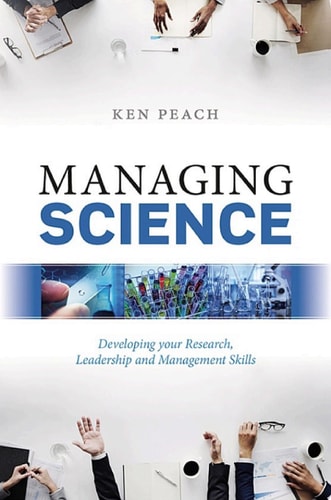
Managing Science: Developing your Research, Leadership and Management Skills
0
0
As an Amazon Associate and affiliate partner, Menrva Books earns from qualifying purchases. Learn more
Author Description
Leadership and management are general skills that apply in most walks of life, but in the scientific domain they require some special characteristics. Science thrives on challenge, whether it is the technical challenge of trying to do something which has not been done before or challenging a widely held but poorly supported hypothesis. Scientists are trained to challenge, and for the manager of science this can itself be a challenge. In the past, when science was on a much smaller scale and less subject to public scrutiny, a less formal 'back-of-the-envelope' management style was acceptable, but those days are long-gone. Science costs much more and is rightly more accountable. Excellent scientists, however, do not necessarily make good managers and may not make good leaders. Nevertheless, like all skills, leadership and management can be enhanced and developed and even instinctively good managers can improve. While the science of management and leadership is well developed, the management and leadership of science is less so. This book aims to introduce the working research scientist to the art and techniques of management and the skills necessary to be a good and effective manager and leader of science and scientists. This includes understanding the organization and functioning of scientific research establishments (universities, laboratories, research councils, etc.) and how to deal with the associated committee work, recruiting, and team building; how to deal with difficulties managing projects and handling risks. The approach is pragmatic not dogmatic. Leadership and management are people skills, and each person is different and needs to be treated differently. The focus is on the principle and practice. While the subject is serious, the approach is conversational, with anecdotes and practical examples.
Menrva's Summary
THE THESIS
This book investigates how research scientists can effectively develop the leadership and management skills necessary to navigate the complexities of modern scientific institutions. Ken Peach, drawing on his experience within scientific research establishments, argues that while scientific training emphasizes critical questioning, the management of science requires a distinct set of interpersonal and organizational competencies. The text provides a pragmatic framework for transitioning from individual research to team leadership, emphasizing that management is a skill set that can be learned and refined.
THE SCOPE MAP
What You Will Find
- Strategies for managing scientific projects and mitigating research risks
- Guidance on navigating organizational structures like universities and laboratories
- Techniques for team building, recruitment, and committee participation
- Practical examples and anecdotes illustrating management principles
Scope Limits
- Does not provide a dogmatic or rigid set of rules for management
- Does not cover general business management outside the specific context of scientific research
THE AUTHORITY PERSPECTIVE
Readers frequently note the conversational and accessible tone of the prose, which balances serious professional advice with practical, real-world examples. Experts highlight this as a useful resource for researchers transitioning into administrative roles who require a bridge between scientific inquiry and organizational leadership.
Page Count:
287
Publication Date:
2017-01-01
Publisher:
OUP Oxford
ISBN-10:
0192515713
ISBN-13:
9780192515711
Science
Professional Development
Management
Earth Sciences
Leadership
Community Tags
Similar Books