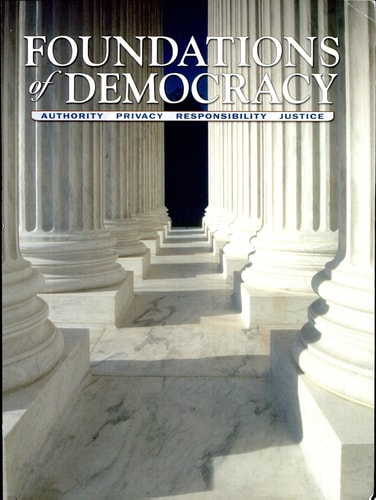
Foundations of Democracy: Authority, Privacy, Responsibility, and Justice
0
0
As an Amazon Associate and affiliate partner, Menrva Books earns from qualifying purchases. Learn more
Author Description
This curriculum is organized around four concepts--authority, privacy, responsibility, and justice--which form part of the common core of civic values and concepts that are fundamental to the theory and practice of democratic citizenship in the United States. Rather than focusing on facts and dates, the curriculum challenges students to think for themselves, to develop reasoned positions, and to articulate and defend their views. By raising issues over the authority of police, teachers and principals, the volume calls on students to question the benefits, costs, and limits of authority and privacy. The textbook also raises questions about how competing responsibilities should be resolved and about the various forms of justice, including distributive, corrective, and procedural justice. Each chapter provides concrete conflicts covering such areas as sporting competitions, locker rooms, computers, and drunk driving, followed by critical thinking exercises requiring students to identify and debate the competing interests. To provide students with an analytical framework for debating the issues, the textbook explains the use of intellectual tools that help students think critically, such as, for example, indentifying the claims for privacy, the relevant considerations, and alternative solutions. (JD)
Menrva's Summary
THE THESIS
This curriculum investigates the fundamental concepts of authority, privacy, responsibility, and justice as they relate to democratic citizenship. It challenges students to think critically about these core civic values, moving beyond rote memorization of facts and dates to develop reasoned positions and articulate their views. The material prompts students to question the benefits, costs, and limits of authority and privacy, explore the resolution of competing responsibilities, and examine various forms of justice.
THE SCOPE MAP
- Core concepts: Authority, Privacy, Responsibility, and Justice
- Focus on critical thinking and reasoned argumentation over factual recall
- Exploration of competing interests and the resolution of conflicts
- Analysis of distributive, corrective, and procedural justice
- Concrete conflict scenarios in areas like sports, locker rooms, and computer use
- Exercises requiring identification and debate of competing interests
- Explanation of intellectual tools for critical analysis
THE AUTHORITY PERSPECTIVE
This curriculum is designed to foster critical thinking and reasoned debate among students regarding foundational democratic principles. Its structure, which emphasizes questioning and analysis of complex issues like authority and justice, suggests a pedagogical approach focused on developing analytical skills. The inclusion of diverse scenarios and intellectual tools indicates a comprehensive effort to equip students with the frameworks needed for informed civic engagement.
Page Count:
244
Publication Date:
1993-01-01
Publisher:
Center for Civic Education
ISBN-10:
089818150X
ISBN-13:
9780898181500
Non-Fiction
Critical thinking
Social Studies
Civics
Education
Government
Community Tags
Similar Books