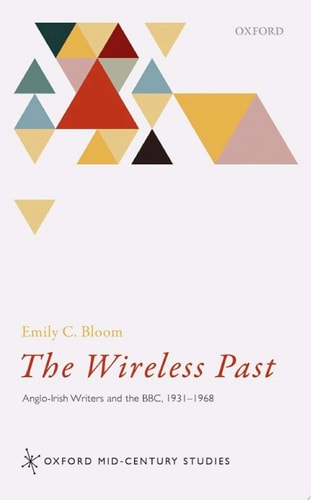
The Wireless Past: Anglo-Irish Writers and the BBC, 1931-1968
0
0
As an Amazon Associate and affiliate partner, Menrva Books earns from qualifying purchases. Learn more
Author Description
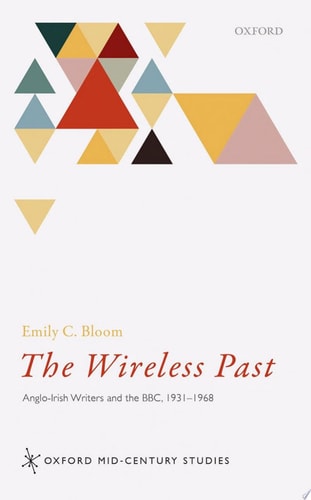
The Oxford Mid-Century Studies series publishes monographs in several disciplinary and creative areas in order to create a thick description of culture in the thirty-year period around the Second World War. With a focus on the 1930s through the 1960s, the series concentrates on fiction, poetry, film, photography, theatre, as well as art, architecture, design, and other media. The mid-century is an age of shifting groups and movements, from existentialism through abstract expressionism to confessional, serial, electronic, and pop art styles. The series charts such intellectual movements, even as it aids and abets the very best scholarly thinking about the power of art in a world under new techno-political compulsions, whether nuclear-apocalyptic, Cold War-propagandized, transnational, neo-imperial, super-powered, or postcolonial. The Wireless Past chronicles the emergence of the British Broadcasting Corporation (BBC) as a significant promotional platform and aesthetic influence for Irish modernism from the 1930s to the 1960s. This is the first book-length study of Irish literary broadcasting on the BBC and situates the works of W. B. Yeats, Elizabeth Bowen, Louis MacNeice, and Samuel Beckett in the context of the media environments that shaped their works. Drawing upon unpublished radio archives, this book shows that radio broadcasting, rather than prompting a break with literary history and traditional literary forms, in fact served as an important means for reinterpreting the legacies of oral and print traditions. In the years surrounding World War II, radio came to be seen as a catalyst for literary revivals and, simultaneously, a force for experimentation. This double valence of radio—the conjoining of revivalism and experimentation—create a distinctive radiogenic aesthetics in mid-century modernism.
Menrva's Summary
THE THESIS
This book investigates how the British Broadcasting Corporation (BBC) functioned as a critical aesthetic and promotional platform for Irish modernist writers between 1931 and 1968. Emily C. Bloom, a scholar of modernism and media, utilizes previously unpublished radio archives to argue that broadcasting did not displace traditional literary forms but instead provided a medium for reinterpreting oral and print legacies. By examining the works of figures like W. B. Yeats and Samuel Beckett, the author demonstrates how radio served as a catalyst for both literary revivalism and formal experimentation.
THE SCOPE MAP
What You Will Find
- Analysis of the intersection between Irish modernism and mid-century broadcasting technology
- Case studies on W. B. Yeats, Elizabeth Bowen, Louis MacNeice, and Samuel Beckett
- Examination of unpublished BBC radio archives and production records
- Theoretical framework regarding 'radiogenic aesthetics'
Scope Limits
- The study is restricted to the period between 1931 and 1968
- The focus is primarily on the BBC's influence on Irish writers rather than a comprehensive history of Irish domestic broadcasting
THE AUTHORITY PERSPECTIVE
Scholars in the field of modernist studies recognize this work as a significant contribution to the understanding of media's role in shaping twentieth-century literature. Readers frequently note the academic rigor of the research and the clarity with which the author connects technological shifts to literary output.
Page Count:
217
Publication Date:
2016-01-01
Publisher:
OUP Oxford
ISBN-10:
0192513176
ISBN-13:
9780192513175
English
Radio_history
Media Studies
English & College Success
Irish literature
Modernism
Cultural History
Literary Criticism