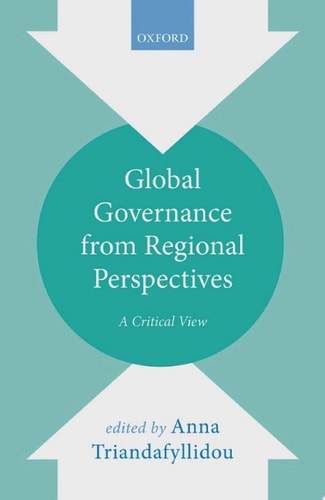
Global Governance from Regional Perspectives: A Critical View
0
0
As an Amazon Associate and affiliate partner, Menrva Books earns from qualifying purchases. Learn more
Author Description
Global Governance from Regional Perspectives argues that the academic debate on global governance has neglected the combination of power with value constellations/culture. Both input and output legitimacy, for instance, or the exercise of control and influence are inextricably related to culture, worldviews, and values. The book questions theoretically the Western hegemonic and hence 'invisible' definition of governance and related concepts, as well as the Western hegemony over global governance institutions. It looks from the ground up whether, and how, alternative practices, institutions/networks, and concepts/norms of global governance are emerging in relation to emerging powers and regional integration systems. Global Governance from Regional Perspectives starts with a critical reading of global governance from multi-disciplinary views and engages with two important and under-studied aspects, notably how global governance can be measured and what lies behind such measurements, and questions the democratic deficit of global governance. The book provides a series of regional and country perspectives on global governance which engage with a specific example of an institution, process, or issue that is used to highlight why and how the western hegemonic views and practices of global governance are (or not) contested. The book offers a mapping of global governance phenomena in different regions of the world and a critical readings of those. As such this volume is different from all international relations or political science collections on global governance and also opens up a new field of study that has been hitherto neglected in sociological or cultural studies.
Menrva's Summary
THE THESIS
This book investigates whether the academic discourse on global governance is constrained by Western hegemony and how cultural values and worldviews influence the legitimacy and exercise of power in international institutions. Anna Triandafyllidou, a prominent scholar in migration and cultural diversity, synthesizes multi-disciplinary perspectives to challenge the 'invisible' Western-centric definitions of governance. The work argues that power dynamics are inextricably linked to regional cultural contexts and seeks to identify how emerging powers are developing alternative practices and norms to contest established global structures.
THE SCOPE MAP
What You Will Find
- A critical analysis of the democratic deficit within global governance institutions.
- Theoretical frameworks for measuring global governance and the biases inherent in such metrics.
- Regional and country-specific case studies examining how local institutions and networks challenge Western-dominated processes.
Scope Limits
- The text does not provide a comprehensive history of every international organization.
- It does not offer a predictive model for the future of global political stability.
THE AUTHORITY PERSPECTIVE
Scholars in international relations and sociology identify this volume as a significant contribution to the study of non-Western perspectives on global power. Readers frequently note the academic density of the prose, which is intended for researchers and advanced students interested in the intersection of culture and international policy.
Page Count:
291
Publication Date:
2017-01-01
Publisher:
OUP Oxford
ISBN-10:
019251184X
ISBN-13:
9780192511843
Sociology
Globalization
International relations
International Cooperation
Community Tags
Similar Books