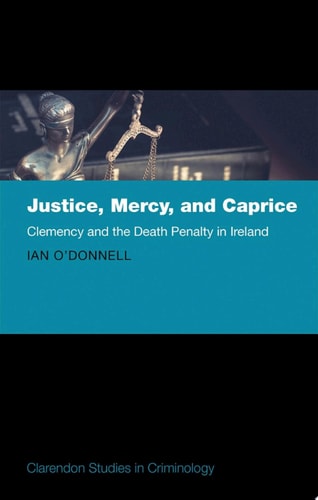
Justice, Mercy, and Caprice: Clemency and the Death Penalty in Ireland
0
0
As an Amazon Associate and affiliate partner, Menrva Books earns from qualifying purchases. Learn more
Author Description
Justice, Mercy, and Caprice is a work of criminal justice history that speaks to the gradual emergence of a more humane Irish state. It is a close examination of the decision to grant clemency to men and women sentenced to death between the end of the civil war in 1923 and the abolition of capital punishment in 1990. Frequently, the decision to deflect the law from its course was an attempt to introduce a measure of justice to a system where the mandatory death sentence for murder caused predictable unfairness and undue harshness. In some instances the decision to spare a life sprang from merciful motivations. In others it was capricious, depending on factors that should have had no place in the government's decision-making calculus. The custodial careers of those whose lives were spared repay scrutiny. Women tended to serve relatively short periods in prison but were often transferred to a religious institution where their confinement continued, occasionally for life. Men, by contrast, served longer in prison but were discharged directly to the community. Political offenders were either executed hastily or, when the threat of capital punishment had passed, incarcerated for extravagant periods. This book addresses issues that are of continuing relevance for countries that employ capital punishment. It will appeal to scholars with an interest in criminal justice history, executive discretion, and death penalty studies, as well as being a useful resource for students of penology.
Menrva's Summary
THE THESIS
This book investigates the historical application of executive clemency in Ireland to determine how justice, mercy, and caprice influenced the state's decision to commute death sentences between 1923 and 1990. Ian O'Donnell, a professor of criminology, utilizes archival records and government case files to analyze the inconsistencies inherent in the Irish capital punishment system. He argues that the mandatory death sentence for murder necessitated a discretionary mechanism that often functioned based on arbitrary factors rather than consistent legal principles.
THE SCOPE MAP
What You Will Find
- Analysis of clemency decisions from the end of the Irish Civil War in 1923 to the abolition of the death penalty in 1990.
- Comparative study of custodial outcomes for men, women, and political offenders.
- Examination of the role of religious institutions in the post-commutation confinement of female offenders.
Scope Limits
- The study does not provide a comprehensive legal history of the Irish court system outside of the specific context of capital sentencing and executive pardon.
- It does not focus on the international legal precedents of capital punishment, remaining primarily centered on the Irish experience.
THE AUTHORITY PERSPECTIVE
Scholars in the field of penology and legal history recognize this work as a rigorous examination of executive discretion and the systemic failures of mandatory sentencing. Readers frequently note the academic density of the prose and the depth of the archival research presented by the author.
Page Count:
329
Publication Date:
2017-01-01
Publisher:
OUP Oxford
ISBN-10:
0192519441
ISBN-13:
9780192519443
Legal History
Professional Career & Trade
Law ireland
Criminology
Irish History
Penology
Community Tags
Similar Books