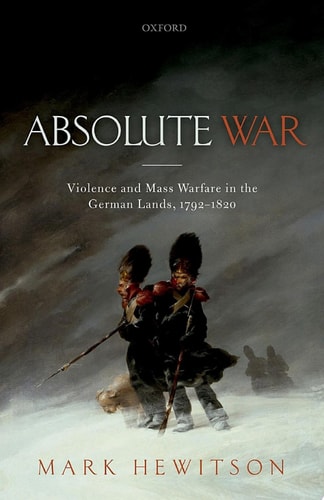
Absolute War: Violence and Mass Warfare in the German Lands, 1792-1820
0
0
As an Amazon Associate and affiliate partner, Menrva Books earns from qualifying purchases. Learn more
Author Description
Wars have played a fundamental part in modern German history. Although infrequent, conflicts involving German states have usually been extensive and often catastrophic, constituting turning-points for Europe as a whole. Absolute War is the first in a series of studies from Mark Hewitson that explore how such conflicts were experienced by soldiers and civilians during wartime, and how they were subsequently imagined and understood during peacetime, from Clausewitz and Kleist to Jünger and Adorno. Without such an understanding, it is difficult to make sense of the dramatic shifts characterising the politics of Germany and Europe over the past two centuries. The studies argue that the ease - or reluctance - with which Germans went to war, and the far-reaching consequences of such wars on domestic politics, were related to soldiers' and civilians' attitudes to violence and death, as well as to long-term transformations in contemporaries' conceptualisation of conflict. Absolute War reassesses the meaning of military conflict for the millions of German subjects who were directly implicated in the Revolutionary and Napoleonic Wars. Based on a re-reading of contemporary diaries, letters, memoirs, official correspondence, press reports, pamphlets, treatises, plays, and cartoons, this volume refocuses attention on combat and conscription as the central components of new forms of mass warfare. It concentrates, in particular, on the impact of violence, killing, and death on many soldiers' and some civilians' experiences and subsequent memories of conflict. War has often been conceived of as 'an act of violence pushed to its utmost bounds', as Clausewitz put it, but the relationship between military conflicts and violent acts remains a problematic one.
Menrva's Summary
THE THESIS
This work investigates how the experience and conceptualization of violence during the Revolutionary and Napoleonic Wars fundamentally shaped the German understanding of mass warfare. Mark Hewitson, a scholar of modern German history, utilizes a vast array of primary sources—including diaries, letters, and official correspondence—to analyze the intersection of combat, conscription, and civilian life. The study argues that the transformation of German domestic politics and the cultural memory of conflict are inextricably linked to how soldiers and civilians processed the reality of death and violence on the battlefield.
THE SCOPE MAP
What You Will Find
- Analysis of the Revolutionary and Napoleonic Wars in German lands from 1792 to 1820.
- Examination of the shift toward mass warfare and the implementation of conscription.
- Qualitative assessment of personal accounts from soldiers and civilians regarding violence and death.
- Cultural analysis of contemporary treatises, plays, and cartoons.
Scope Limits
- The study focuses specifically on the German lands and does not provide a comprehensive military history of the entire European theater.
- The analysis is limited to the period between 1792 and 1820 and does not extend into later German conflicts.
THE AUTHORITY PERSPECTIVE
Historians recognize this volume as a significant contribution to the social history of warfare, particularly for its focus on the subjective experience of combatants. Readers frequently note the academic density of the prose and the meticulous use of primary source material to challenge traditional top-down military narratives.
Page Count:
315
Publication Date:
2017-01-01
Publisher:
OUP Oxford
ISBN-10:
0192513958
ISBN-13:
9780192513953
History
German history
European History
Military History
Germany history
Social History
Community Tags
Similar Books