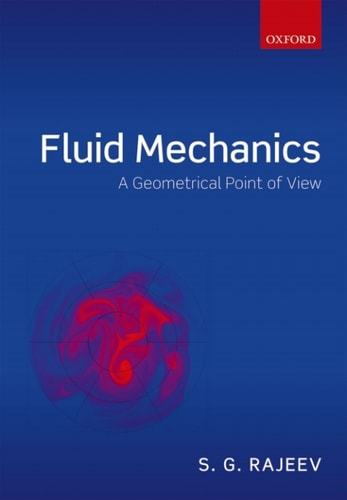
Fluid Mechanics: A Geometrical Point of View
0
0
As an Amazon Associate and affiliate partner, Menrva Books earns from qualifying purchases. Learn more
Author Description
Fluid Mechanics: A Geometrical Point of View emphasizes general principles of physics illustrated by simple examples in fluid mechanics. Advanced mathematics (e.g., Riemannian geometry and Lie groups) commonly used in other parts of theoretical physics (e.g. General Relativity or High Energy Physics) are explained and applied to fluid mechanics. This follows on from the author's book Advanced Mechanics (Oxford University Press, 2013). After introducing the fundamental equations (Euler and Navier-Stokes), the book provides particular cases: ideal and viscous flows, shocks, boundary layers, instabilities, and transients. A restrained look at integrable systems (KdV) leads into a formulation of an ideal fluid as a hamiltonian system. Arnold's deep idea, that the instability of a fluid can be understood using the curvature of the diffeomorphism group, will be explained. Leray's work on regularity of Navier-Stokes solutions, and the modern developments arising from it, will be explained in language for physicists. Although this is a book on theoretical physics, readers will learn basic numerical methods: spectral and finite difference methods, geometric integrators for ordinary differential equations. Readers will take a deep dive into chaotic dynamics, using the Smale horse shoe as an example. Aref's work on chaotic advection is explained. The book concludes with a self-contained introduction to renormalization, an idea from high energy physics which is expected to be useful in developing a theory of turbulence.
Menrva's Summary
THE THESIS
This text investigates the application of advanced geometric and algebraic methods to the fundamental principles of fluid mechanics. Author S. G. Rajeev, a physicist, utilizes his background in theoretical mechanics to bridge the gap between classical fluid dynamics and the sophisticated mathematical frameworks typically reserved for general relativity and high-energy physics. By framing fluid motion through the lens of Riemannian geometry and Lie groups, the book argues that complex phenomena like turbulence and instability can be understood through rigorous geometric analysis.
THE SCOPE MAP
What You Will Find
- Application of Riemannian geometry and Lie groups to Euler and Navier-Stokes equations
- Analysis of ideal and viscous flows, boundary layers, and shock waves
- Introduction to Hamiltonian formulations of ideal fluids
- Numerical methods including spectral and finite difference techniques
- Exploration of chaotic dynamics and renormalization in the context of turbulence
Scope Limits
- The text assumes a strong foundation in theoretical physics and advanced mathematics
- It does not serve as an introductory manual for general engineering fluid mechanics
THE AUTHORITY PERSPECTIVE
Experts recognize this work as a specialized bridge between high-level mathematical physics and fluid dynamics. Readers frequently note the high density of the prose, which requires significant prior knowledge of differential geometry and classical mechanics to fully comprehend.
Page Count:
272
Publication Date:
2018-01-01
Publisher:
OUP Oxford
ISBN-10:
0192527215
ISBN-13:
9780192527219
Mathematics
Fluids
Physics
Differential Geometry
Theoretical Physics
Earth Sciences
Community Tags
Similar Books