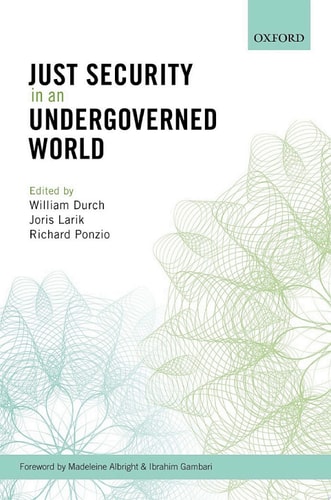
Just Security in an Undergoverned World
0
0
As an Amazon Associate and affiliate partner, Menrva Books earns from qualifying purchases. Learn more
Author Description
Just Security in an Undergoverned World examines how humankind can manage global problems to achieve both security and justice in an age of antithesis. Global connectivity is increasing, visibly and invisiblyin trade, finance, culture, and informationhelping to spur economic growth, technological advance, and greater understanding and freedom, but global disconnects are growing as well. Ubiquitous electronics rely on high-value minerals scraped from the earth by miners kept poor by corruption and war. People abandon burning states for the often indifferent welcome of wealthier lands whose people, in turn, draw into themselves. Humanity's very success, underwritten in large part by lighting up gigatons of long-buried carbon for 200 years, now threatens humanity's future. The global governance institutions established after World War II to manage global threats, especially the twin scourges of war and poverty, have expanded in reach and impact, while paradoxically losing the political support of some of their wealthiest and most powerful members. Their problems mimic those of their members in struggling to adapt to new problems and maintain trust in norms and public bodies. This volume argues, however, that a properly mandated, managed, and modernized global architecture offers unparalleled potential to midwife solutions to intractable issuesfrom violent conflict and climate change to poverty and pandemic diseasethat transcend borders and the capacities of individual actors. It offers just security as a new framework for charing innovating solutions and strategies for effective and essential global governance.
Menrva's Summary
THE THESIS
This volume investigates how the international community can reconcile the dual imperatives of security and justice within a global landscape increasingly defined by systemic disconnects and institutional instability. The authors, drawing on extensive expertise in international law and global policy, argue that the post-World War II governance architecture requires significant modernization to address contemporary transnational threats. They propose the framework of 'just security' as a mechanism to align global institutions with the realities of climate change, economic inequality, and violent conflict.
THE SCOPE MAP
What You Will Find
- Analysis of the decline in political support for established international institutions.
- A proposed 'just security' framework for addressing cross-border challenges.
- Examination of the intersection between technological advancement and global resource exploitation.
Scope Limits
- The text does not provide a comprehensive history of every individual international organization.
- It does not offer specific legislative blueprints for individual nation-states to implement.
THE AUTHORITY PERSPECTIVE
Experts in international relations identify this work as a significant contribution to the discourse on institutional reform and global governance. Readers frequently note the academic rigor of the prose and the practical application of the proposed framework for policymakers.
Page Count:
540
Publication Date:
2018-01-01
Publisher:
OUP Oxford
ISBN-10:
0192527827
ISBN-13:
9780192527820
Law Courts
International relations
International Security
Sociology
Public Policy
Community Tags
Similar Books