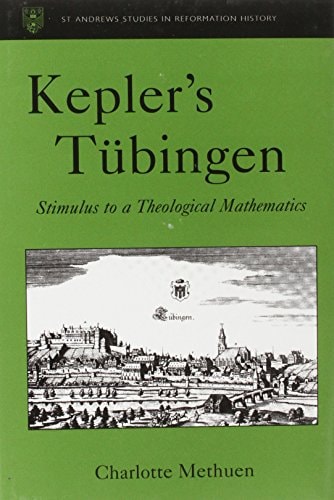
Kepler's Tübingen: Stimulus to a Theological Mathematics (St Andrews Studies in Reformation History)
0
0
As an Amazon Associate and affiliate partner, Menrva Books earns from qualifying purchases. Learn more
Author Description
Using previously unstudied sources, this interdisciplinary study considers theology and the beginnings of modern science at the University of Tübingen in the time of Johannes Kepler (1571-1630). The author casts light upon the origins of modern scientific method by examining the relationship between theology, astronomy and dialectics at the university in the work of Kepler’s teachers. Studies of Kepler generally treat him as a precursor of the modern scientist; the influences upon him are identified as Platonist or Pythagorean and his theological interests have often been ignored, or considered as a mystical aberration, unworthy of in-depth treatment. There has been no serious attempt to place Kepler’s work in the wider tradition of mainstream 16th-century thought. This study portrays and analyses the influences and ideas which permeated the life of the university in Tübingen in the second half of the 16th century and places them in relationship to the theology of Martin Luther and Philip Melanchthon. It pays particular attention to the use of theological concepts, astronomical observations, logical demonstrations and the categories of physics, and to the interplay between them.
Page Count:
292
Publication Date:
1998-06-28
Publisher:
Routledge
ISBN-10:
1859283977
ISBN-13:
9781859283974