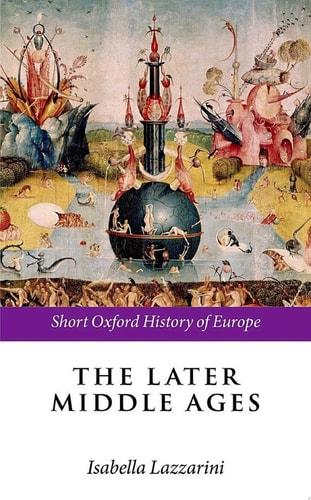
The Later Middle Ages
0
0
As an Amazon Associate and affiliate partner, Menrva Books earns from qualifying purchases. Learn more
Author Description
Of all the sub-periods in which European medieval history has been divided over time, the later middle ages is possibly the one on which the burden of past and current grand narratives weighs the most. Its chronological and geopolitical boundaries are shaped by a heavy narrative of decline or transition, and consequently this period is often interpreted through the lenses of previous or following developments, becoming in turn the tail-end of the 'feudal', 'communal', 'imperial versus papal' era or the announcement of modernity. The Later Middle Ages addresses the urgent need to revise and rewrite the story of this period, forging new critical and technical vocabularies not derived from the study of other periods. By adopting a conscious approach towards temporal and spatial variety, and by breaking the traditional and unitary narrative of decline and transition into one of many changes and continuities, it charts the principal developments of late medieval Europe while opening up to different political cultures and societies, throwing new light on older concepts, and revealing analogies and differences with other geopolitical contexts. Including maps, illustrations, a detailed chronology and a rich range of reading suggestions, The Later Middle Ages aims at providing a first introduction to a very complex, dynamic, and fascinating period for Europe and beyond.
Menrva's Summary
THE THESIS
This book investigates the historical period of the later middle ages by challenging traditional grand narratives of decline and transition. The author, writing within the Short Oxford History of Europe series, argues for a revisionist approach that avoids viewing this era merely as a precursor to modernity or the conclusion of feudalism. By utilizing a framework that emphasizes temporal and spatial variety, the text seeks to establish a new critical vocabulary for understanding late medieval European political cultures and social structures.
THE SCOPE MAP
What You Will Find
- Analysis of late medieval political cultures and societal shifts
- Comparative study of European geopolitical contexts
- Chronological and thematic breakdown of historical continuities
- Pedagogical aids including maps, illustrations, and reading lists
Scope Limits
- Does not provide an exhaustive encyclopedic account of every regional event
- Avoids the traditional singular narrative of decline or transition
THE AUTHORITY PERSPECTIVE
Experts and students frequently identify this text as a valuable introductory resource for navigating the complexities of late medieval historiography. Readers often note the academic rigor of the prose, which successfully balances broad historical synthesis with specific, nuanced analysis.
Page Count:
318
Publication Date:
2021-01-01
Publisher:
OUP Oxford
ISBN-10:
0192529331
ISBN-13:
9780192529336
History
Non-Fiction
European History
Academic
Community Tags
Similar Books