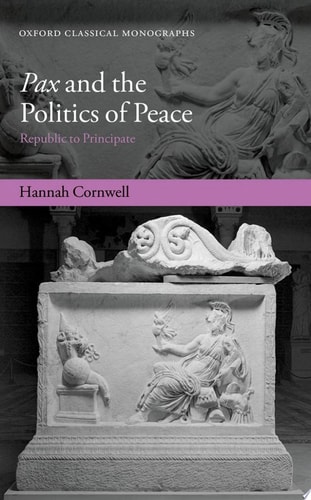
Pax and the Politics of Peace
0
0
As an Amazon Associate and affiliate partner, Menrva Books earns from qualifying purchases. Learn more
Author Description
Perhaps in defiance of expectations, Roman peace (pax) was a difficult concept that resisted any straightforward definition: not merely denoting the absence or aftermath of war, it consisted of many layers and associations and formed part of a much greater discourse on the nature of power and how Rome saw her place in the world. During the period from 50 BC to AD 75 - covering the collapse of the Republic, the subsequent civil wars, and the dawn of the Principate-the traditional meaning and language of peace came under extreme pressure as pax was co-opted to serve different strands of political discourse. This volume argues for its fundamental centrality in understanding the changing dynamics of the state and the creation of a new political system in the Roman Empire, moving from the debates over the content of the concept in the dying Republic to discussion of its deployment in the legitimization of the Augustan regime, first through the creation of an authorized version controlled by the princeps and then the ultimate crystallization of the Pax Augusta as the first wholly imperial concept of peace. Examining the nuances in the various meanings, applications, and contexts of Roman discourse on peace allows us valuable insight into the ways in which the dynamics of power were understood and how these were contingent on the political structures of the day. However it also demonstrates that although the idea of peace came to dominate imperial Rome's self-representation, such discourse was nevertheless only part of a wider discussion on the way in which the empire conceptualized itself.
Menrva's Summary
THE THESIS
This volume investigates how the concept of 'pax' (peace) functioned as a contested political tool during the transition from the Roman Republic to the Principate. Hannah Cornwell, a scholar of Roman history, analyzes the evolution of peace as a rhetorical and ideological construct. By examining primary sources and political discourse from 50 BC to AD 75, the author argues that peace was not a static state but a dynamic instrument used to legitimize power and define the Roman state's identity.
THE SCOPE MAP
What You Will Find
- Analysis of the shift from Republican-era debates to the Augustan regime's controlled narrative.
- Examination of the 'Pax Augusta' as a foundational imperial concept.
- Investigation into the linguistic and political nuances of Roman self-representation.
Scope Limits
- The study is strictly confined to the period between 50 BC and AD 75.
- The work does not provide a comprehensive military history of the era, focusing instead on political discourse.
THE AUTHORITY PERSPECTIVE
Scholars and historians recognize this work as a rigorous examination of Roman political ideology and the manipulation of state concepts. Readers frequently note the academic density of the prose, which is well-suited for students and researchers of classical history.
Page Count:
272
Publication Date:
2017-01-01
Publisher:
Oxford University Press
ISBN-10:
0192528130
ISBN-13:
9780192528131
History
Ancient - Rome
Political Philosophy
Community Tags
Similar Books