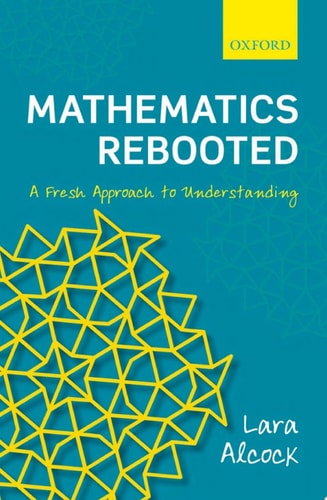
Mathematics Rebooted: A Fresh Approach to Understanding
0
0
As an Amazon Associate and affiliate partner, Menrva Books earns from qualifying purchases. Learn more
Author Description
Would you like to understand more mathematics? Many people would. Perhaps at school you liked mathematics for a while but were then put off because you missed a key idea and kept getting stuck. Perhaps you always liked mathematics but gave it up because your main interest was music or languages or science or philosophy. Or perhaps you studied mathematics to advanced levels, but have now forgotten most of what you once knew. Whichever is the case, this book is for you. It aims to build on what you know, revisiting basic ideas with a focus on meaning. Each chapter starts with an idea from school mathematics - often primary school mathematics - and gradually builds up a network of links to more advanced material. It explores fundamental ideas in depth, using insights from research in mathematics education and psychology to explain why people often get confused, and how to overcome that confusion. For nervous readers, it will build confidence by clarifying basic ideas. For more experienced readers, it will highlight new connections to more advanced material. Throughout, the book explains how mathematicians think, and how ordinary people can understand and enjoy mathematical ideas and arguments. If you would like to be better informed about the intrinsic elegance of mathematics, this engaging guide is the place to start.
Menrva's Summary
THE THESIS
This book investigates how to bridge the gap between foundational school-level mathematics and advanced conceptual understanding by focusing on the underlying meaning of mathematical ideas. Lara Alcock, a reader in mathematics education at Loughborough University, utilizes her expertise in cognitive psychology and pedagogical research to dismantle common barriers to learning. She presents a framework that connects elementary arithmetic and geometry to higher-level abstract concepts, aiming to demystify the subject for both novices and those returning to the discipline.
THE SCOPE MAP
What You Will Find
- Explanations of fundamental mathematical concepts starting from primary school levels
- Cognitive strategies for overcoming common points of confusion in mathematical reasoning
- Insights into the thought processes and logical structures used by professional mathematicians
- Connections between basic arithmetic, algebra, and advanced mathematical theory
Scope Limits
- The text does not serve as a comprehensive textbook or a collection of practice exercises for formal examinations
- It does not cover specialized applied mathematics or computational programming techniques
THE AUTHORITY PERSPECTIVE
Experts and educators frequently highlight this work as a valuable resource for bridging the gap between rote memorization and true conceptual fluency. Readers often note that the prose is accessible yet intellectually rigorous, making it a standard recommendation for those seeking to regain confidence in their mathematical abilities.
Page Count:
252
Publication Date:
2017-01-01
Publisher:
OUP Oxford
ISBN-10:
0192525948
ISBN-13:
9780192525949
Non-Fiction
Science
Mathematics
Self Help
Mathematics - General
Education
Mathematics Statistics
Community Tags
Similar Books