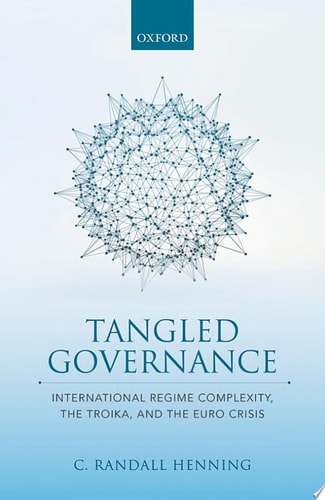
Tangled Governance
0
0
As an Amazon Associate and affiliate partner, Menrva Books earns from qualifying purchases. Learn more
Author Description
Tangled Governance addresses the institutions that were deployed to fight the Euro crisis, reestablish financial stability in Europe, and prevent contagion to the rest of the world. Henning explains why European leaders chose to include the International Monetary Fund (IMF) in the crisis response and provides a detailed account of the decisions of the institutions that make up the Troika (the European Commission, European Central Bank, and IMF). He examines the institutions negotiating strategies, the outcomes of their interaction, and the effectiveness of their cooperation. The institutional strategies of key member states, including Germany and the United States, are also explored in this study. The book locates its analysis within the framework of regime complexity, involving clusters of overlapping and intersecting regional and multilateral institutions. It tests conjectures in the regime-complexity literature against the seven cases of financial rescues of Euro area countries that were stricken by crises between 2010 and 2015. Tangled Governance concludes that states use some institutions to control others, that complexity is the consequence of a strategy to control agency drift. States mediate conflicts among institutions and thereby limit fragmentation of the regime complex and underpin substantive efficacy. In reaching these conclusions, the book also answers several key puzzles, including why Germany and other Northern European countries supported IMF inclusion despite its adopting positions opposed to their preferences; why crisis fighting arrangements endured intense conflicts among the institutions; and, finally, why the United States and the IMF promoted further steps to complete the monetary union.
Menrva's Summary
THE THESIS
This book investigates why European leaders integrated the International Monetary Fund into the response to the Eurozone crisis and how this institutional arrangement functioned. C. Randall Henning, a professor of international relations, utilizes the framework of regime complexity to analyze the interactions between the European Commission, the European Central Bank, and the IMF. He argues that states deliberately employ overlapping institutions as a strategic mechanism to mitigate agency drift and maintain control over crisis management outcomes.
THE SCOPE MAP
What You Will Find
- Analysis of seven specific financial rescue cases in the Euro area between 2010 and 2015.
- A theoretical framework regarding regime complexity and institutional interaction.
- Examination of the strategic motivations of key actors, specifically Germany and the United States.
Scope Limits
- The study focuses primarily on the period between 2010 and 2015 and does not cover subsequent developments in the Eurozone.
- The analysis is restricted to the institutional dynamics of the Troika and does not provide a comprehensive history of the Euro currency itself.
THE AUTHORITY PERSPECTIVE
Experts in international political economy recognize this work as a rigorous application of regime complexity theory to contemporary financial crises. Readers frequently note the academic density of the prose, which is intended for scholars and policy analysts interested in institutional design and European governance.
Page Count:
312
Publication Date:
2017-01-01
Publisher:
Oxford University Press
ISBN-10:
0192521950
ISBN-13:
9780192521958
Economics
Public Policy
International relations
Financial History
Community Tags
Similar Books