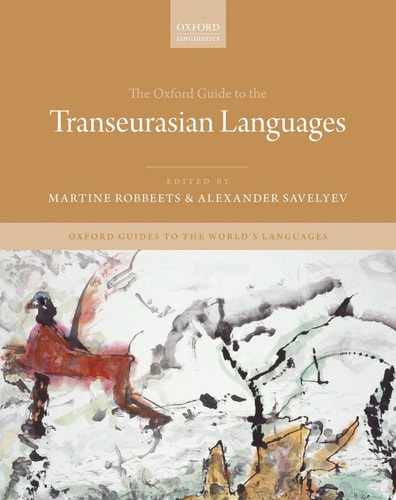
The Oxford Guide to the Transeurasian Languages
0
0
As an Amazon Associate and affiliate partner, Menrva Books earns from qualifying purchases. Learn more
Author Description
The Oxford Guide to the Transeurasian Languages provides a comprehensive account of the Transeurasian languages, and is the first major reference work in the field since 1965. The term 'Transeurasian' refers to a large group of geographically adjacent languages that includes five uncontroversial linguistic families: Japonic, Koreanic, Tungusic, Mongolic, and Turkic. The historical connection between these languages, however, constitutes one of the most debated issues in historical comparative linguistics. In the present book, a team of leading international scholars in the field take a balanced approach to this controversy, integrating different theoretical frameworks, combining both functional and formal linguistics, and showing that genealogical and areal approaches are in fact compatible with one another. The volume is divided into five parts. Part I deals with the historical sources and periodization of the Transeurasian languages and their classification and typology. In Part II, chapters provide individual structural overviews of the Transeurasian languages and the linguistic subgroups that they belong to, while Part III explores Transeurasian phonology, morphology, syntax, lexis, and semantics from a comparative perspective. Part IV offers a range of areal and genealogical explanations for the correlations observed in the preceding parts. Finally, Part V combines archaeological, genetic, and anthropological perspectives on the identity of speakers of Transeurasian languages. The Oxford Guide to the Transeurasian Languages will be an indispensable resource for specialists in Japonic, Koreanic, Tungusic, Mongolic, and Turkic languages and for anyone with an interest in Transeurasian and comparative linguistics more broadly.
Menrva's Summary
THE THESIS
This volume investigates the historical and structural connections between the five language families collectively known as Transeurasian: Japonic, Koreanic, Tungusic, Mongolic, and Turkic. Edited by Alexander Savelyev and Martine Robbeets, the work assembles a team of international scholars to address the long-standing debate regarding the genealogical versus areal relationships among these languages. By integrating functional and formal linguistic frameworks with interdisciplinary data from archaeology, genetics, and anthropology, the authors present a comprehensive synthesis of current research in the field.
THE SCOPE MAP
What You Will Find
- Structural overviews of Japonic, Koreanic, Tungusic, Mongolic, and Turkic language families
- Comparative analysis of phonology, morphology, syntax, lexis, and semantics
- Integration of archaeological, genetic, and anthropological evidence regarding speaker identity
- Historical periodization and classification methodologies
Scope Limits
- Does not provide exhaustive grammars for every individual language within the groups
- Does not claim to definitively resolve all debates regarding the Transeurasian hypothesis
THE AUTHORITY PERSPECTIVE
Experts recognize this volume as the first major reference work on the subject since 1965, serving as a critical resource for specialists in comparative linguistics. Readers frequently note the academic density of the prose and the rigorous interdisciplinary approach taken by the contributors.
Page Count:
976
Publication Date:
2020-01-01
Publisher:
OUP Oxford
ISBN-10:
0192526782
ISBN-13:
9780192526786
Academic
English & College Success
Philology
Historical linguistics
Linguistics
Reference
English
Community Tags
Similar Books