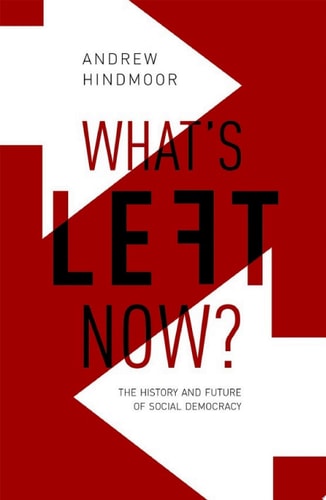
What's Left Now?: The History and Future of Social Democracy
0
0
As an Amazon Associate and affiliate partner, Menrva Books earns from qualifying purchases. Learn more
Author Description
Our sense of history shapes how we think about ourselves. One of the distinguishing features of the left in Britain is that it holds to a remorselessly bleak and miserabilist view of our recent political history -- one in which Margaret Thatcher's election in 1979 marked the start of a still-continuing fall from political grace made evident by the triumph of a free market get-what-you-can neoliberal ideology, dizzying levels of inequality, social decay, rampant individualism, state authoritarianism, and political corruption. The left does not like what has happened to us and it does not like what we have become. Andrew Hindmoor argues that this history is wrong and self-harming. It is wrong because Britain has in many respects become a more politically attractive and progressive country over the last few decades. It is self-harming because this bleak history undermines faith in politics. Post-Brexit, post-Grenfell, and post the 2010, 2015, and 2017 general elections, things may not, right now, look that great. But looked at over the longer haul, Britain is a long way from being a posterchild for neoliberalism. Left-wing ideas and arguments have shaped and continue to shape our politics.
Menrva's Summary
THE THESIS
This book investigates whether the prevailing narrative of decline within the British left is historically accurate or if it obscures genuine progress made in the post-1979 era. Andrew Hindmoor, a professor of politics, challenges the common perception that neoliberalism has completely dismantled social democratic values in Britain. By analyzing long-term political trends rather than short-term electoral cycles, he argues that the left's insistence on a narrative of total defeat is both factually flawed and politically counterproductive.
THE SCOPE MAP
What You Will Find
- Analysis of British political history from 1979 to the present.
- Evaluation of social democratic influence on contemporary policy.
- Examination of the impact of neoliberalism on social and economic structures.
- Critique of political discourse and historical memory within the left.
Scope Limits
- The text focuses primarily on the British political context.
- It does not provide a comprehensive global history of social democracy.
THE AUTHORITY PERSPECTIVE
Scholars and political commentators note that Hindmoor provides a provocative counter-narrative to standard accounts of British political decline. The text is recognized for its analytical rigor and its attempt to reframe the debate regarding the efficacy of left-wing political influence.
Page Count:
296
Publication Date:
2018-01-01
Publisher:
OUP Oxford
ISBN-10:
0192528688
ISBN-13:
9780192528681
History
Politics
Sociology
Right and left Political science
European History
British Politics
Community Tags
Similar Books