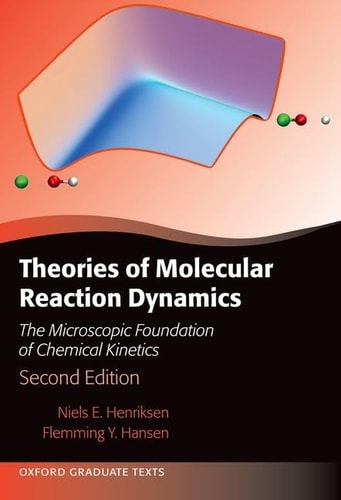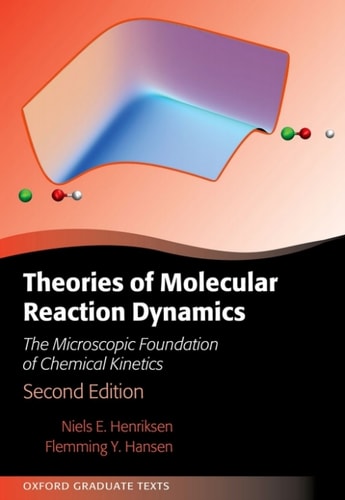
Theories of Molecular Reaction Dynamics: The Microscopic Foundation of Chemical Kinetics
0
0
As an Amazon Associate and affiliate partner, Menrva Books earns from qualifying purchases. Learn more
Author Description
This book deals with a central topic at the interface of chemistry and physics--the understanding of how the transformation of matter takes place at the atomic level. Building on the laws of physics, the book focuses on the theoretical framework for predicting the outcome of chemical reactions. The style is highly systematic with attention to basic concepts and clarity of presentation. The emphasis is on concepts and insights obtained via analytical theories rather than computational and numerical aspects. Molecular reaction dynamics is about the detailed atomic-level description of chemical reactions. Based on quantum mechanics and statistical mechanics, the dynamics of uni- and bi-molecular elementary reactions are described. The book features a comprehensive presentation of transition-state theory which plays an important role in practice, and a detailed discussion of basic theories of reaction dynamics in condensed phases. Examples and end-of-chapter problems are included in order to illustrate the theory and its connection to chemical problems. The second edition includes updated descriptions of adiabatic and non-adiabatic electron-nuclear dynamics, an expanded discussion of classical two-body models of chemical reactions, including the Langevin model, additional material on quantum tunnelling and its implementation in Transition-State Theory, and a more thorough description of the Born and Onsager models for solvation.
Menrva's Summary
THE THESIS
How can the transformation of matter be understood through the lens of atomic-level microscopic dynamics? Authors Flemming Y. Hansen and Niels E. Henriksen provide a systematic theoretical framework for predicting chemical reaction outcomes by grounding their analysis in quantum and statistical mechanics. The text prioritizes conceptual insights and analytical derivations over numerical computation, offering a rigorous foundation for graduate-level study in physical chemistry.
THE SCOPE MAP
What You Will Find
- Theoretical frameworks for uni- and bi-molecular elementary reactions
- Comprehensive coverage of transition-state theory
- Analytical models for electron-nuclear dynamics and quantum tunnelling
- Discussion of solvation models including Born and Onsager frameworks
- End-of-chapter problems to reinforce theoretical application
Scope Limits
- Does not focus on computational or numerical simulation methods
- Excludes extensive experimental data sets in favor of theoretical derivation
THE AUTHORITY PERSPECTIVE
Experts recognize this text as a foundational resource for graduate students seeking a deep understanding of the physical principles governing chemical kinetics. Readers frequently note the high level of mathematical and conceptual density, which requires a solid background in quantum mechanics to fully utilize.
Page Count:
464
Publication Date:
2018-01-01
Publisher:
OUP Oxford
ISBN-10:
0192527207
ISBN-13:
9780192527202
Physics
Chemical reaction Conditions and laws of
Statistical mechanics
Chemical Kinetics
Chemistry
Physical Chemistry
Earth Sciences
Academic Textbooks