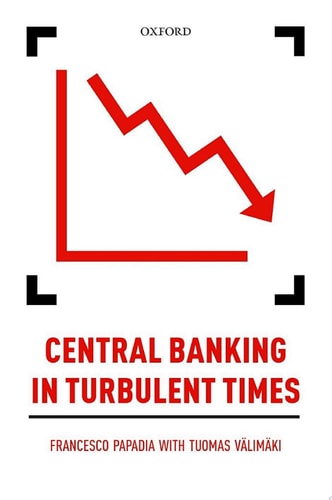
Central Banking in Turbulent Times
0
0
As an Amazon Associate and affiliate partner, Menrva Books earns from qualifying purchases. Learn more
Author Description
Central banks came out of the Great Recession with increased power and responsibilities. Indeed, central banks are often now seen as 'the only game in town', and a place to put innumerable problems vastly exceeding their traditional remit. These new powers do not fit well, however, with the independence of central banks, remote from the democratic control of government. Central Banking in Turbulent Times examines fundamental questions about the central banking system, asking whether the model of an independent central bank devoted to price stability is the final resting point of a complex development that started centuries ago. It dissects the hypothesis that the Great Recession has prompted a reassessment of that model; a renewed emphasis on financial stability has emerged, possibly vying for first rank in the hierarchy of objectives of central banks. This raises the risk of dilemmas, since the Great Recession brought into question implicit assumptions that the pursuit of price stability would also lead to financial stability. In addition, the border between monetary and fiscal policy was blurred both in the US and in Europe. Central Banking in Turbulent Times asks whether the model prevailing before the Great Recession has been irrevocably altered. Are we entering, as Charles Goodhart has hypothesized, into the 'fourth epoch' of central banking? Are changes to central banks part of a move away from the global liberal order that seemed to have prevailed at the turn of the century? Central Banking in Turbulent Times seeks to answer these questions as it examines how changes can allow for the maintenance of price stability, while adapting to the long-term consequences of the Great Recession.
Menrva's Summary
THE THESIS
This book investigates whether the post-Great Recession expansion of central bank mandates and powers has fundamentally compromised the traditional model of independent, price-stability-focused monetary institutions. Authors Francesco Papadia and Tuomas Välimäki, both experienced practitioners in the field of European central banking, utilize historical analysis and economic theory to evaluate the shifting hierarchy of objectives—specifically the tension between price stability and financial stability. They argue that the blurring lines between monetary and fiscal policy necessitate a critical reassessment of the institutional framework that has governed central banks for decades.
THE SCOPE MAP
What You Will Find
- Analysis of the 'fourth epoch' hypothesis regarding central bank evolution.
- Examination of the shifting relationship between monetary and fiscal policy in the US and Europe.
- Evaluation of the trade-offs between central bank independence and democratic accountability.
Scope Limits
- The text does not provide a comprehensive history of central banking prior to the 20th century.
- It does not offer specific investment advice or predictive modeling for individual market participants.
THE AUTHORITY PERSPECTIVE
Experts and academic reviewers recognize this work as a rigorous examination of the institutional challenges facing modern monetary authorities. Readers frequently note the technical density of the prose, which is best suited for those with a foundational understanding of macroeconomic policy and central bank operations.
Page Count:
346
Publication Date:
2018-01-01
Publisher:
OUP Oxford
ISBN-10:
0192528882
ISBN-13:
9780192528889
Economics
Banking law
Finance
Macroeconomics
Money & BankingMonetary Theory
Community Tags
Similar Books