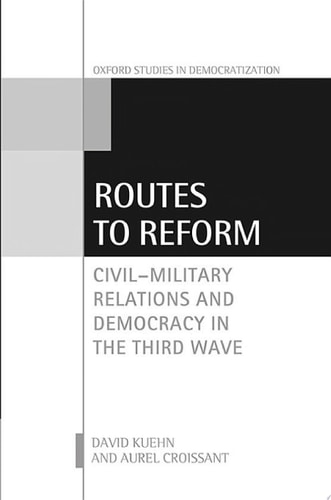
Routes to Reform: Civil-Military Relations and Democracy in the Third Wave
0
0
As an Amazon Associate and affiliate partner, Menrva Books earns from qualifying purchases. Learn more
Author Description
This book examines the conditions under which new democracies succeed or fail in establishing firm and lasting civilian control of the military. David Kuehn and Aurel Croissant introduce a multi-dimensional conceptual framework to evaluate the degree of civilian control in new democracies and to trace developments over time. The theory of civilian control in new democracies that they propose integrates rationalist, structuralist, and institutionalist arguments into a coherent model to explain when, how, and through which causal mechanism new democracies succeed or fail in establishing and sustaining civilian control over the military. This theory is tested on an original dataset on civilian control over the military in 66 countries that have made the transition from authoritarian to democratic rule at least once in the period from 1974 to 2010. The study traces the effects of different degrees of civilian control on the survival and democratic quality of third wave democracies, combining large-N statistical analyses with detailed case study narratives of several countries. The book establishes a comprehensive understanding of the conditions and processes under which third wave democracies succeeded or failed in establishing firm and lasting civilian control of the military-and its consequences for the survival and quality of the new democratic structures, processes, and practices.
Menrva's Summary
THE THESIS
This book investigates the causal mechanisms and structural conditions that determine whether new democracies successfully establish and maintain civilian control over their military institutions. Aurel Croissant and David Kuehn, both established scholars in comparative politics and democratization, synthesize rationalist, structuralist, and institutionalist theories into a unified analytical framework. By applying this model to a broad dataset of post-authoritarian states, they argue that the degree of civilian oversight is a primary determinant of democratic survival and institutional quality.
THE SCOPE MAP
What You Will Find
- A multi-dimensional conceptual framework for measuring civilian control.
- Large-N statistical analysis covering 66 countries transitioning to democracy between 1974 and 2010.
- Comparative case study narratives illustrating specific transition outcomes.
Scope Limits
- The analysis is restricted to the 'third wave' of democratization period (1974-2010).
- The study does not address military-civilian dynamics in established, long-standing Western democracies.
THE AUTHORITY PERSPECTIVE
Experts in the field of civil-military relations recognize this work as a rigorous, data-driven contribution to the study of democratic consolidation. Scholars frequently cite the text for its methodological transparency and its ability to bridge the gap between quantitative statistical modeling and qualitative political history.
Page Count:
407
Publication Date:
2023-01-01
Publisher:
OUP Oxford
ISBN-10:
0192525026
ISBN-13:
9780192525024
Civil-military relations
Comparative Politics
International relations
Community Tags
Similar Books