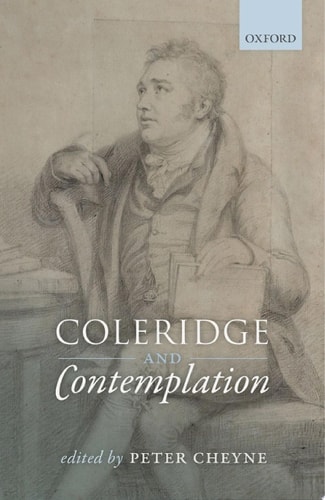
Coleridge and Contemplation
0
0
As an Amazon Associate and affiliate partner, Menrva Books earns from qualifying purchases. Learn more
Author Description
Coleridge and Contemplation is a multi-disciplinary volume on Samuel Taylor Coleridge, founding poet of British Romanticism, critic, and author of philosophical, political, and theological works. In his philosophical writings, Coleridge developed his thinking about the symbolizing imagination, a precursor to contemplation, into a theory of contemplation itself, which for him occurs in its purest form as a manifestation of 'Reason'. Coleridge is a particularly challenging figure because he was a thinker in process, and something of an omnimath, a Renaissance man of the Romantic era. The dynamic quality of his thinking, the 'dark fluxion' pursued but ultimately 'unfixable by thought', and his extensive range of interests make a philosophical yet also multi-disciplinary approach to Coleridge essential. This book is the first collection to feature philosophers and intellectual historians writing on Coleridge's philosophy. This volume opens up a neglected aspect of the work of Britain's greatest philosopher-poet — his analysis of contemplation, which he considered the highest of human mental powers. Philosophers including Roger Scruton, David E. Cooper, Michael McGhee, Andy Hamilton, and Peter Cheyne contribute original essays on the philosophical, literary, and political implications of Coleridge's views. The volume is edited and introduced by Peter Cheyne, and Baroness Mary Warnock contributes a foreword. The chapters by philosophers are supported by new developments in philosophically minded criticism from leading Coleridge scholars in English departments, including Jim Mays, Kathleen Wheeler, and James Engell. They approach Coleridge as an energetic yet contemplative thinker concerned with the intuition of ideas and the processes of cultivation in self and society. Other chapters, from intellectual historians and theologians, including Douglas Hedley clarify the historical background, and 'religious musings', of Coleridge's thought regarding contemplation.
Menrva's Summary
THE THESIS
This volume investigates the philosophical, literary, and theological dimensions of Samuel Taylor Coleridge’s theory of contemplation as the highest human mental power. Edited by Peter Cheyne, the collection assembles contributions from philosophers, intellectual historians, and literary scholars to analyze how Coleridge’s concept of 'Reason' informs his broader intellectual output. By examining Coleridge as an 'omnimath' whose thought remained in a state of constant flux, the authors provide a framework for understanding his work as a cohesive, albeit complex, system of inquiry.
THE SCOPE MAP
What You Will Find
- Analysis of Coleridge’s theory of the symbolizing imagination and its relation to contemplation.
- Multi-disciplinary essays covering the intersection of philosophy, politics, and theology.
- Perspectives from both academic philosophers and specialized Coleridge scholars.
Scope Limits
- The text does not provide a comprehensive biography of Coleridge’s life.
- It does not attempt to resolve all contradictions within Coleridge’s evolving philosophical system.
THE AUTHORITY PERSPECTIVE
Experts highlight this collection as a significant contribution to the study of Coleridge, specifically for bridging the gap between English department literary criticism and formal philosophical analysis. Readers frequently note the academic density of the prose, which is intended for scholars and advanced students of Romanticism and intellectual history.
Page Count:
354
Publication Date:
2017-01-01
Publisher:
OUP Oxford
ISBN-10:
0192520156
ISBN-13:
9780192520159
Philosophy
Biography
English
Intellectual History
Romanticism
English & College Success
Theology
Literary Criticism
Community Tags
Similar Books